
It can be difficult to predict what works in an exhibition will be a crowd favorite, but for the CAT’s current exhibition, Meet Me in the Forest, it was easy to guess that Kate Clement’s Stain would be a standout with our visitors. Stain is a glittering, gravity-defying mystery. The work is made of only two materials: crushed glass and fishing line.
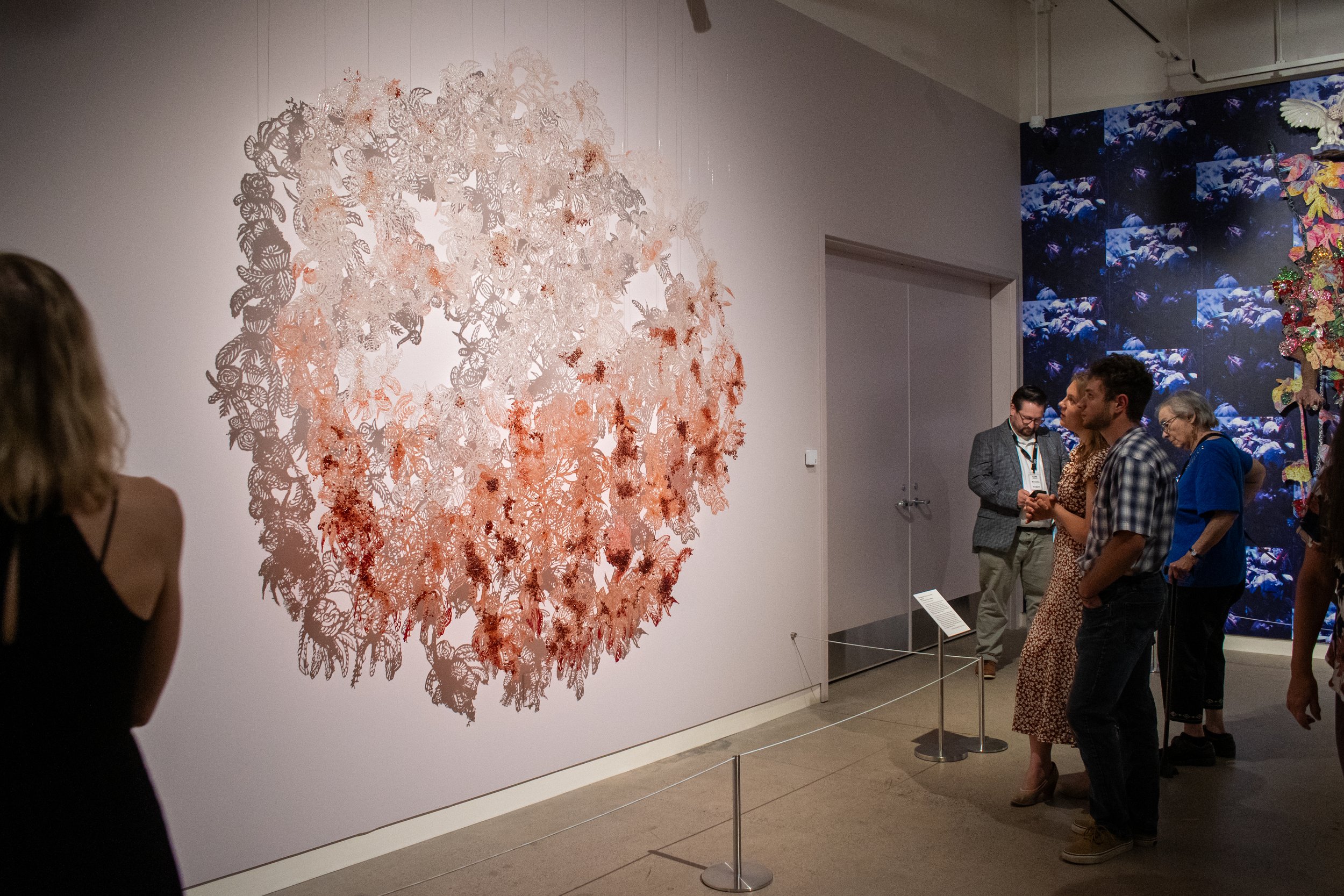
Photo: Kate Clements (American, born 1989). Stain, 2016, Kiln fired glass and monofilament, 90 x 96 x 1/4 inches, Cafesjian Art Trust Museum, 2025.049.1 © Kate Clements
When I first encountered Kate’s work, I was struck by the singular way she works with glass frit the consistency of sugar. The size of kilns or reheating furnaces often limit artists who work with glass, but Kate discovered a way to make large-scale compositions despite working with kilns much smaller than her final works. Stain is made up of 43 separate pieces and is tied together by almost invisible monofilament fishing line. The way Kate pushes boundaries of technique and scale drew me to her work. When planning Meet Me in the Forest with my co-curator, Jill Ahlberg Yohe, I was excited by the prospect of bringing in a new glass acquisition for the CAT. Already on the exhibition checklist were longtime heavy hitters in the glass field: Paul Stankard, Christina Bothwell, and Hiroshi Yamano. What newcomer could I add to the exhibition that could sit side-by-side with glass royalty and give us a peak into the future of contemporary studio glass? To me, Kate’s work fit the bill perfectly.
Bringing a work like Stain into the CAT’s permanent collection was no easy feat, but I knew that our skilled collections team, and Kate’s guidance could make it possible. The first step was to bring Stain from Kate’s studio in Kansas City to the Minnesota. The sculpture is about 8 feet by 8 feet and only 1/8 to ¼ of an inch thick! How do you pack and transport a delicate and giant artwork like this? Luckily, Kate is very organized. She had already designed and created a storage system for Stain. Stackable foam trays held the 43 pieces, which Kate gave numbers and held in place with T-pins.
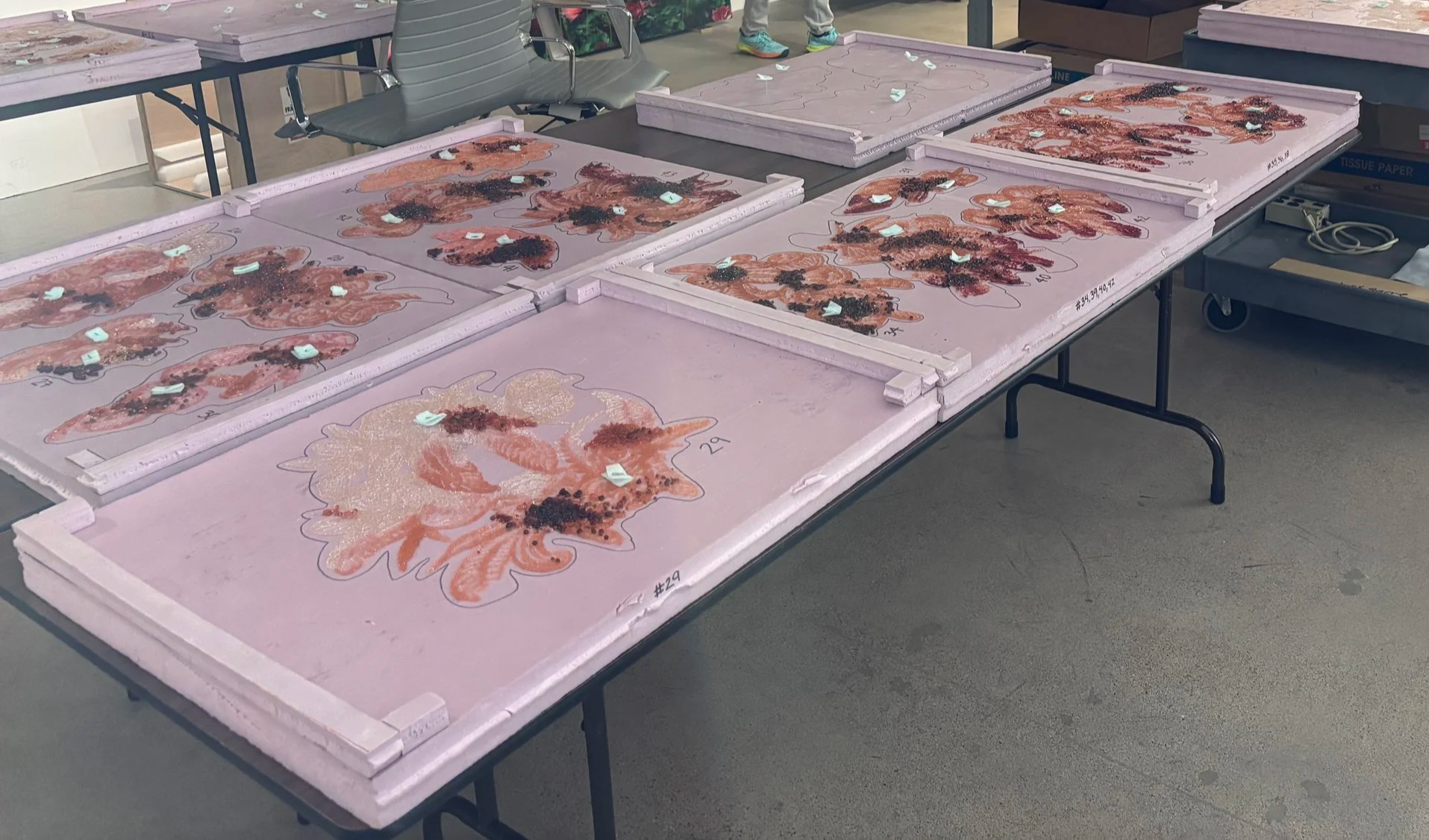
Photo: Glass elements packed into custom trays.
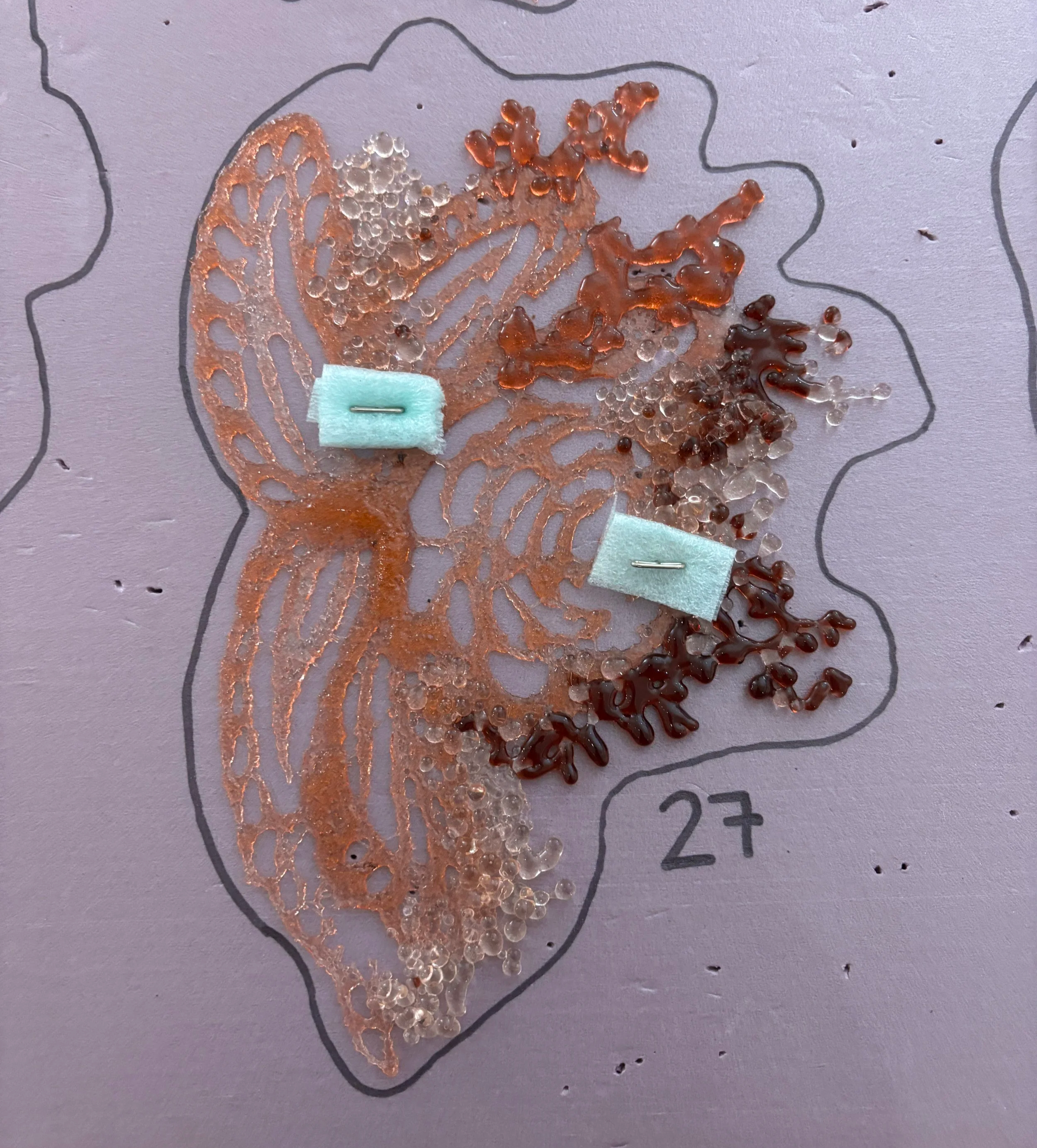
Photo: Piece #27 in its storage tray. The numbers corresponded to the map Kate created.
My main partner in transporting Stain and installing it in our gallery was Manuel Rodriguez, Preparator here at the CAT. Last year Manuel and I packed up the CAT’s van and drove the almost seven hours to Kate’s studio in Kansas City. Kate showed us how she creates the fused glass elements of her sculptures, and gave us a sneak peek of work she was creating for her upcoming exhibition, Chyrsalis, at Studios Inc. in Kansas City. We packed up the fifteen foam trays holding the pieces of Stain into custom carboard boxes that Manuel had built back at the CAT.
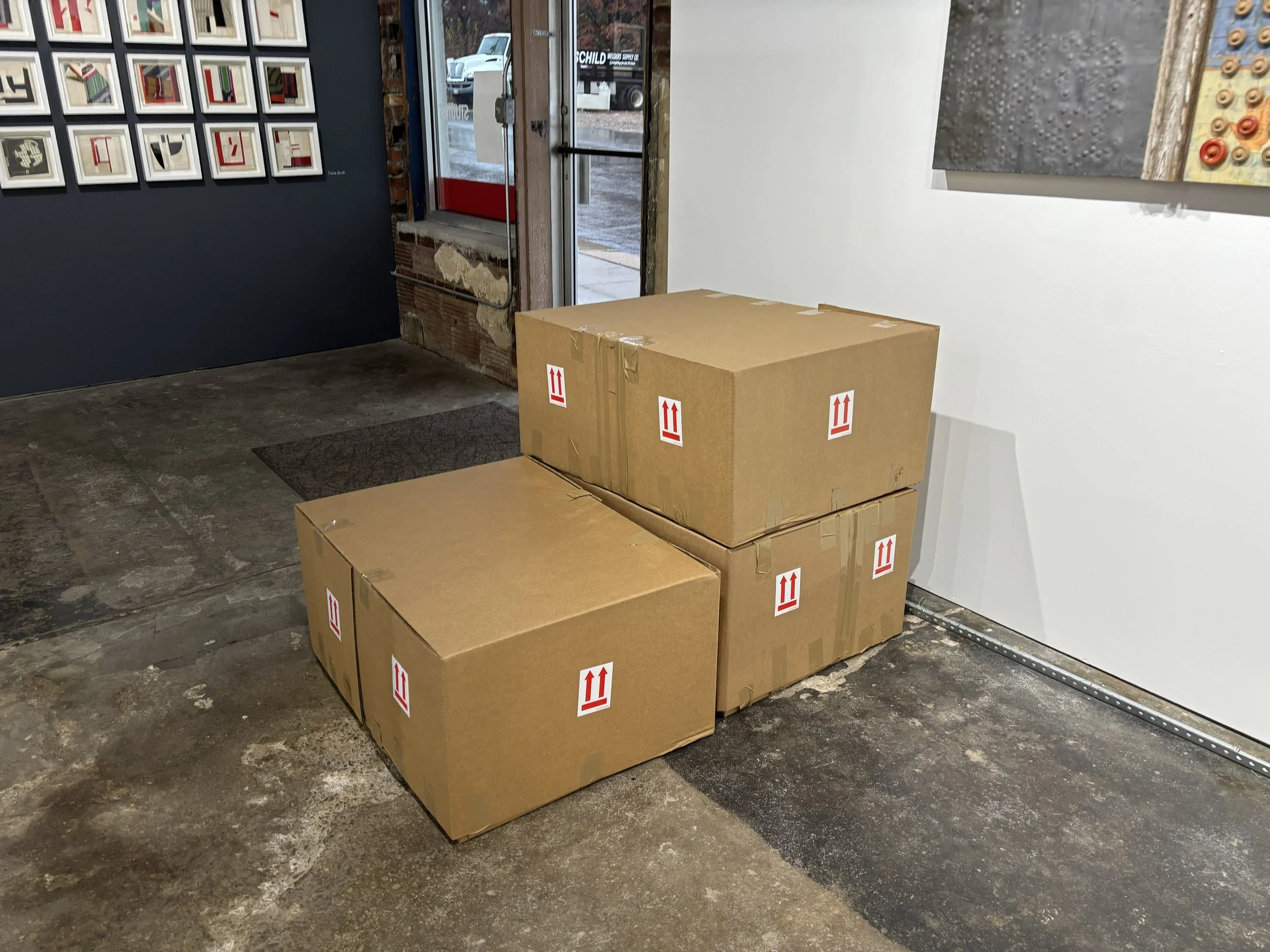
Photo: Trays packed inside boxes at Kate’s studio. Ready to load into the van.
Kate was also kind enough to bring Manuel and me to the Nelson-Atkins Museum of Art to see her sculpture that was on view in the exhibition, Personal Best. Manuel and I studied Kate’s monumental triumphal arch, titled Acanthus, to inform how we would install Stain. The complex network of monofilament and aircraft cable coming from the ceiling was daunting, but Manuel and I recognized that our task would be much simpler. Stain was a single flat surface while Acanthus was three-dimensional.
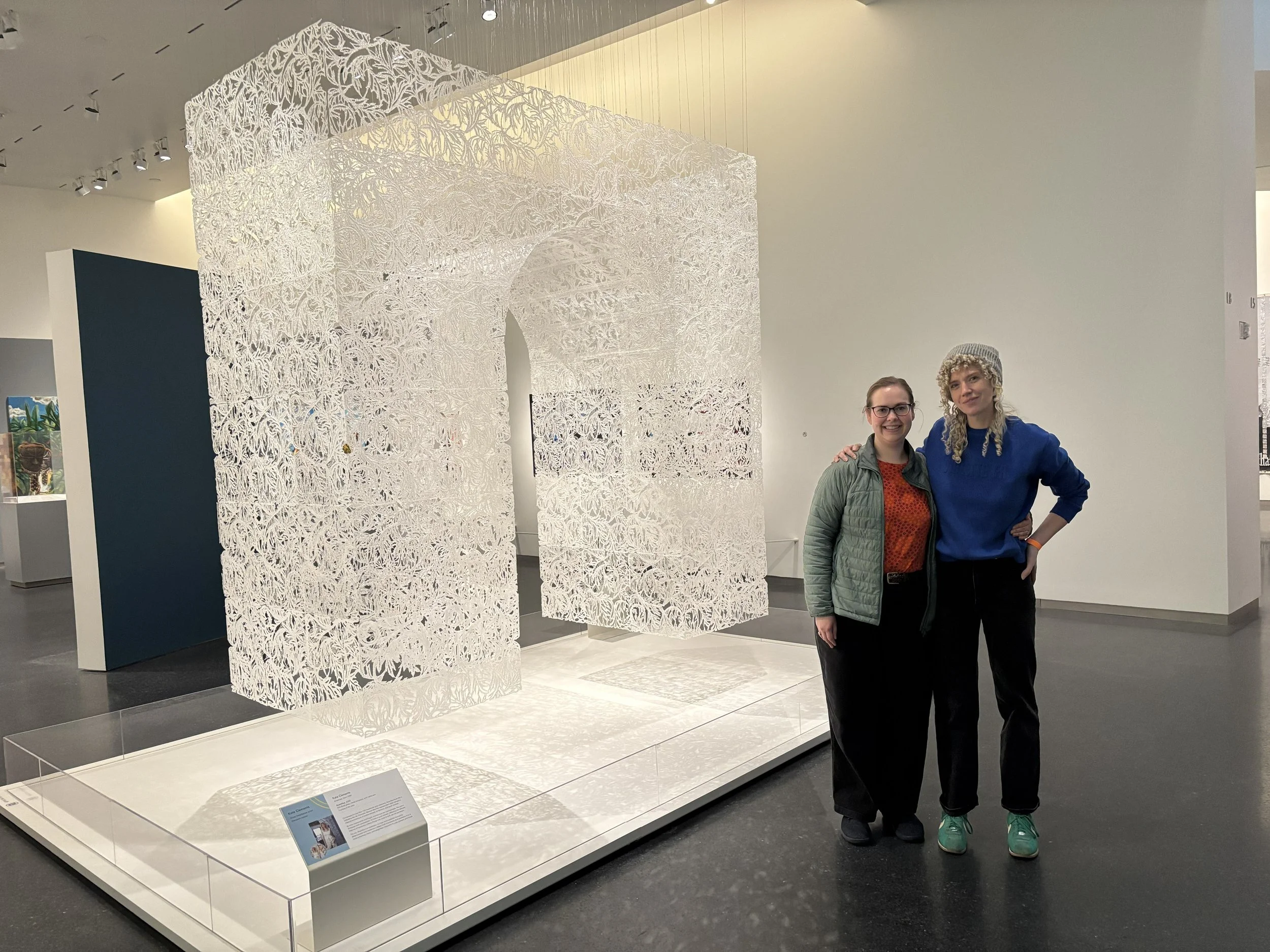
Photo: Kate (right) and me (left) next to Acanthus at the Nelson-Atkins Museum of Art.
In the lead up to installation, the collections team and I had several Zoom meetings with Kate to create an installation plan. Almost nine months after we picked up Stain from Kate’s studio, it was time to put the sculpture together for Meet Me in the Forest. First, we hung a map on the wall that Kate had provided. The plastic tarpaulin featured a marker outline of all 43 pieces in their intended place.
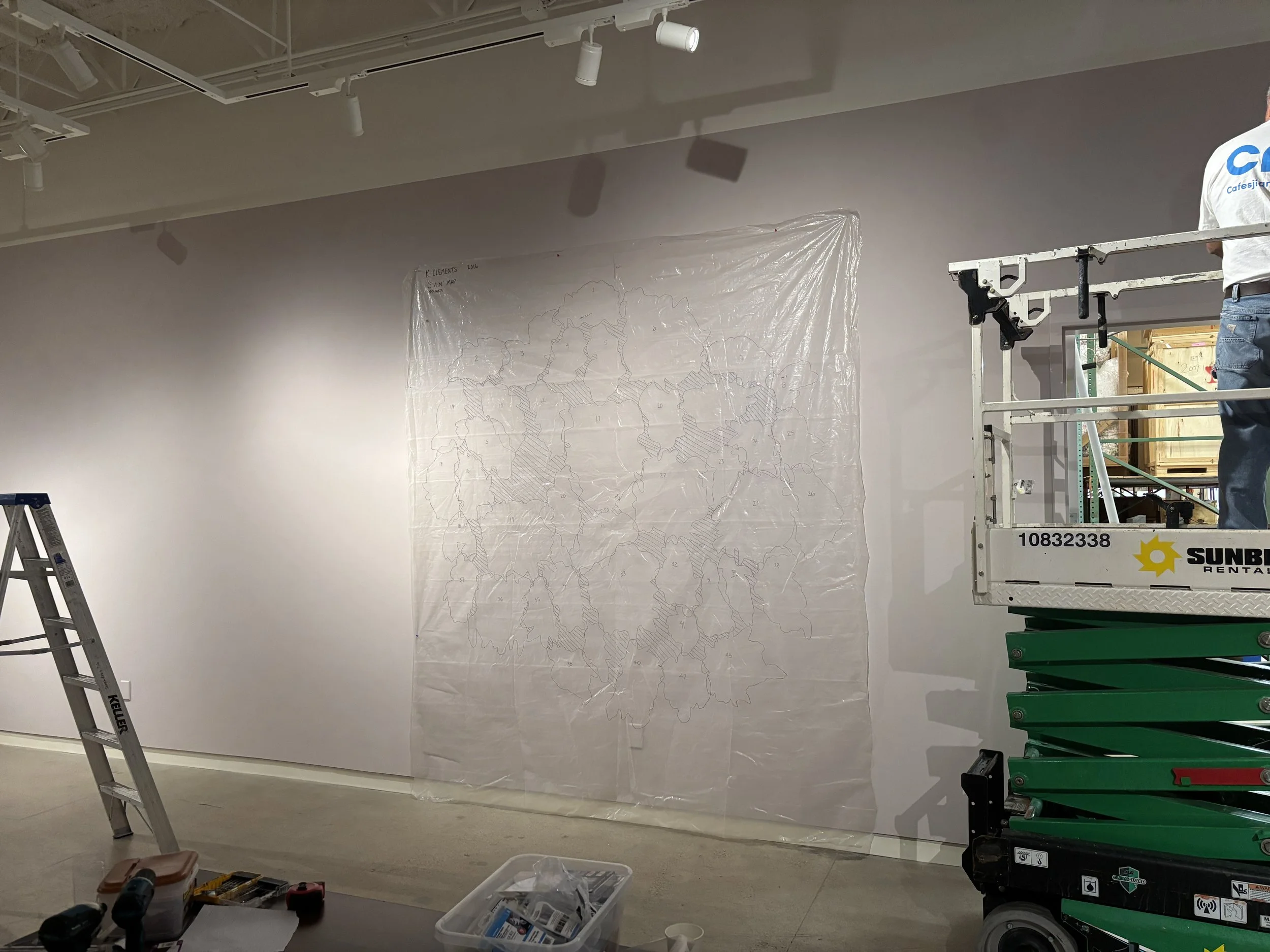
Photo: Plastic tarpaulin map.
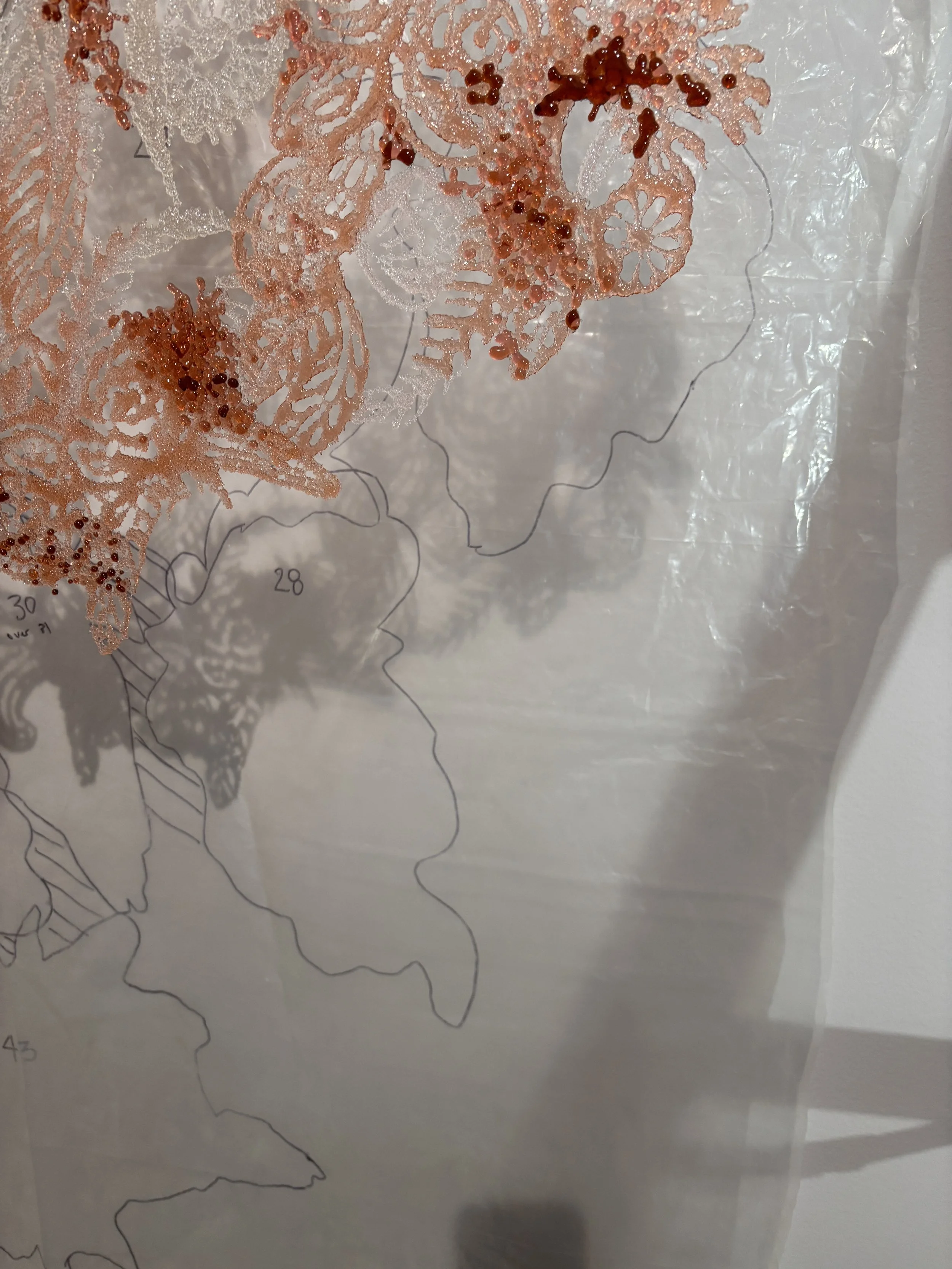
Photo: Detail of the tarpaulin map.
Next, above the tarpaulin, we mounted onto the wall a wooden dowel that Manuel and another preparator at the CAT, Elia Bettaglio, had prepared. We received help installing from Josh Pieper, Senior Project Manager at Museum Services, who often gives us an extra hand during exhibition installations. Using a scissor lift to reach, Manuel and Josh crimped/tied seventeen lengths of monofilament to the dowel, which hung down to hold the topmost elements of the sculpture.
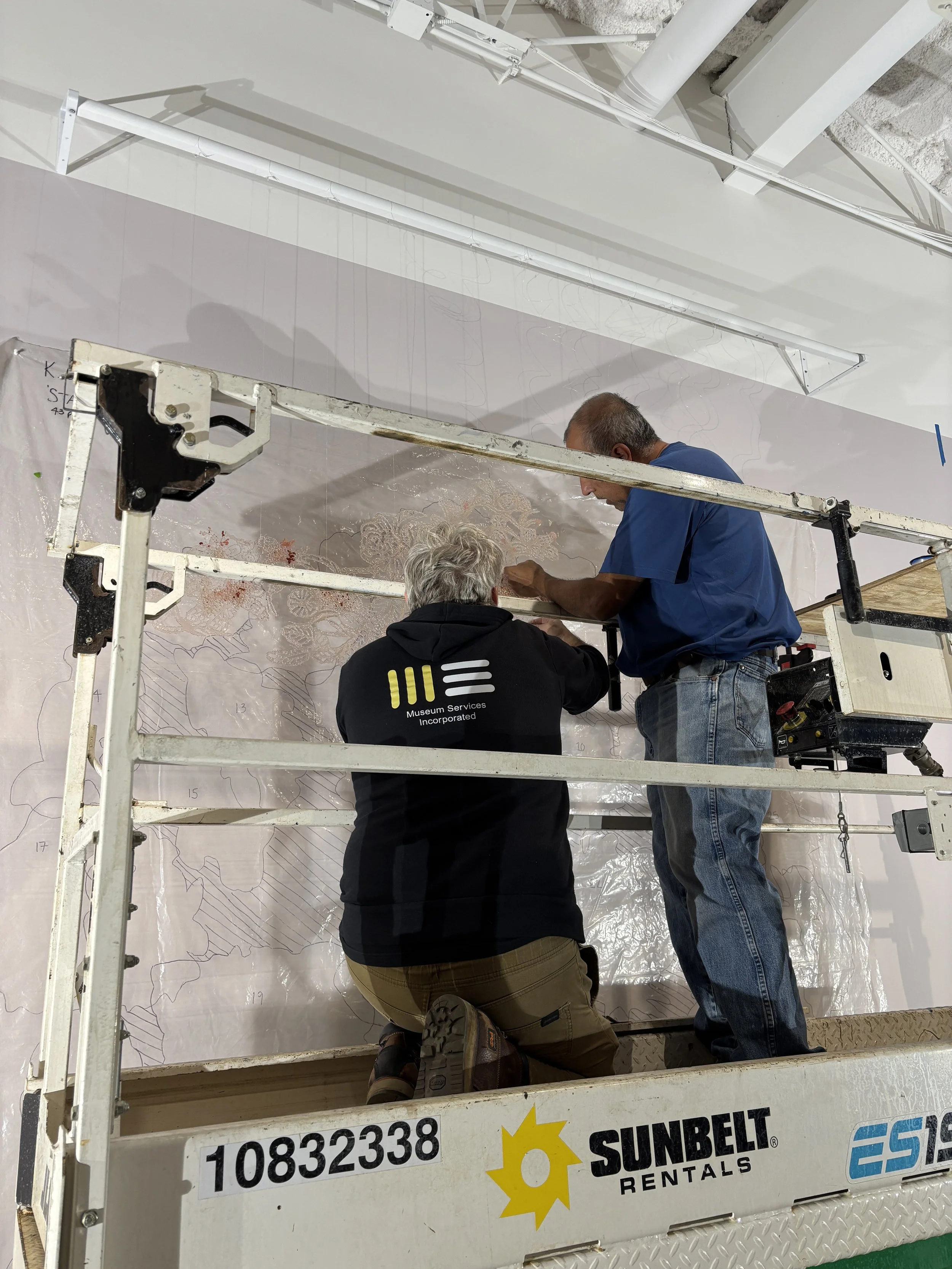
Photo: Josh and Manuel on the scissor lift. Wooden dowel seen above.
Now it was time for the glass. Elia unpinned the first piece from the foam tray (aptly numbered one), carefully picked it up, and handed it to Josh on the scissor lift. He then held it 6-inches from the wall, in front of its corresponding spot on the map. Manuel then took a length of hanging monofilament, looped twice it through an open spot near the top of the glass piece, and double knotted it.
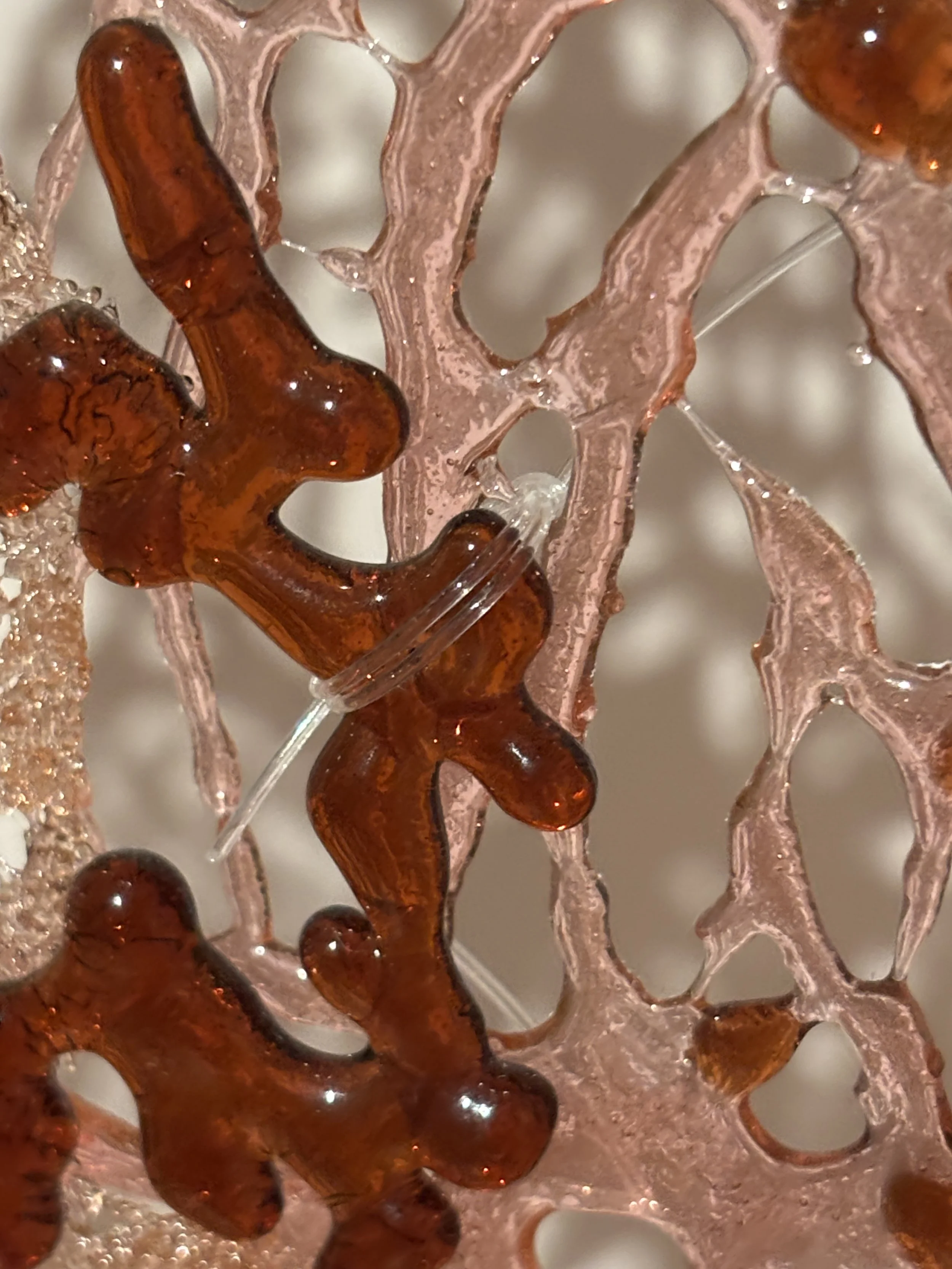
Photo: Close-up of a knot.
They repeated this process with the six pieces that made up the first row, as well as tying each piece to the one next to it. After the first row, we ditched the scissor lift in favor of a ladder, and each subsequent piece was tied to the pieces above and adjacent. It took two days to complete the installation, and Manuel tied every single knot. It was a nerve-wracking experience for all, but the result was awe-inspiring.
The next step after installation was lighting. Our first attempts fell flat. Multiple lights pointing at the sculpture created complicated shadows on the walls that overwhelmed the sculpture.
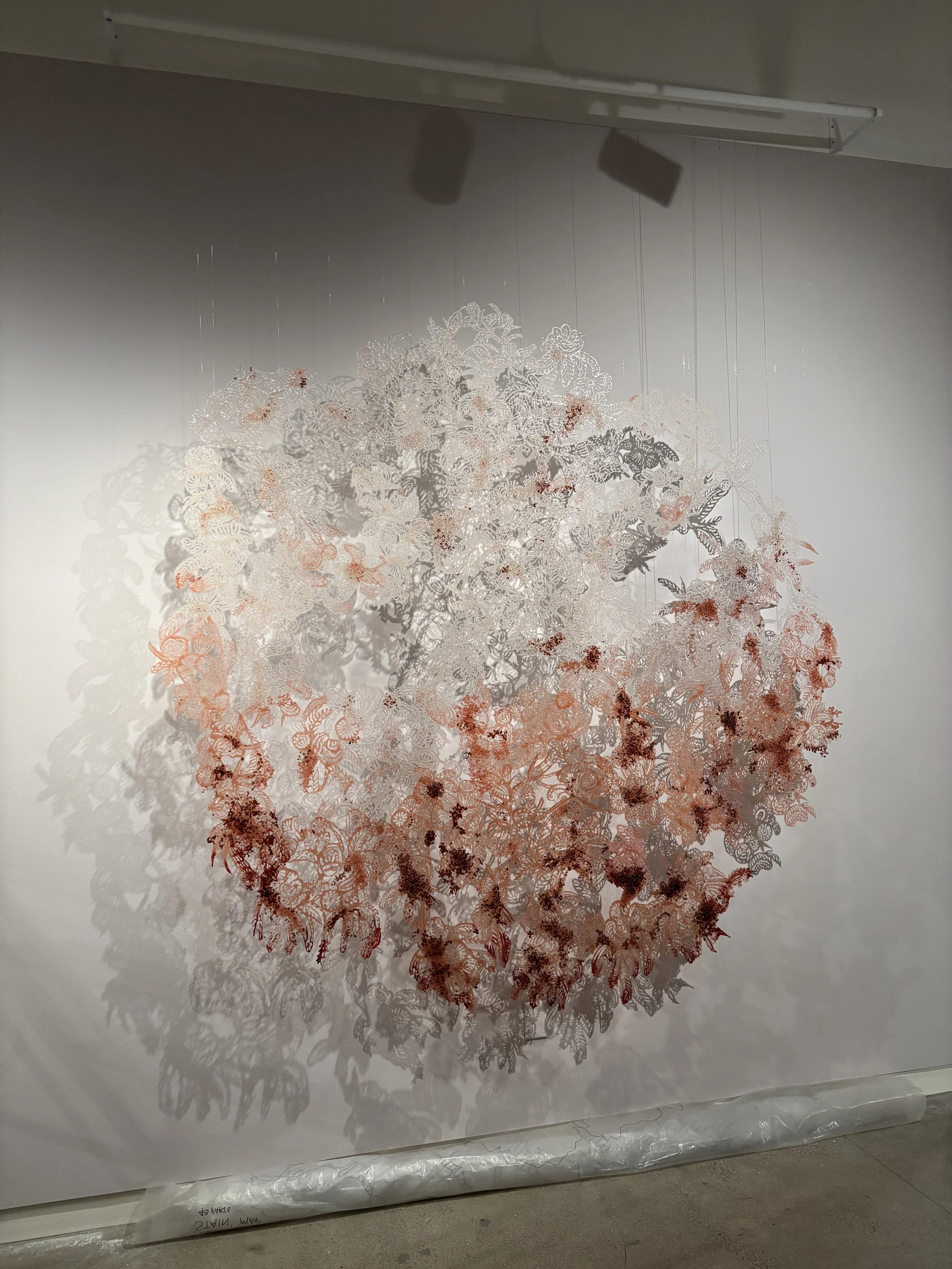
Photo: Lighting from multiple angles.
After some experimentation, we discovered that a single light, centered on Stain created sharp shadows on the wall that appeared like a second element of the sculpture. Visitors are shocked to find out that these beautiful grey “drawings” on the wall are in fact just a shadow.
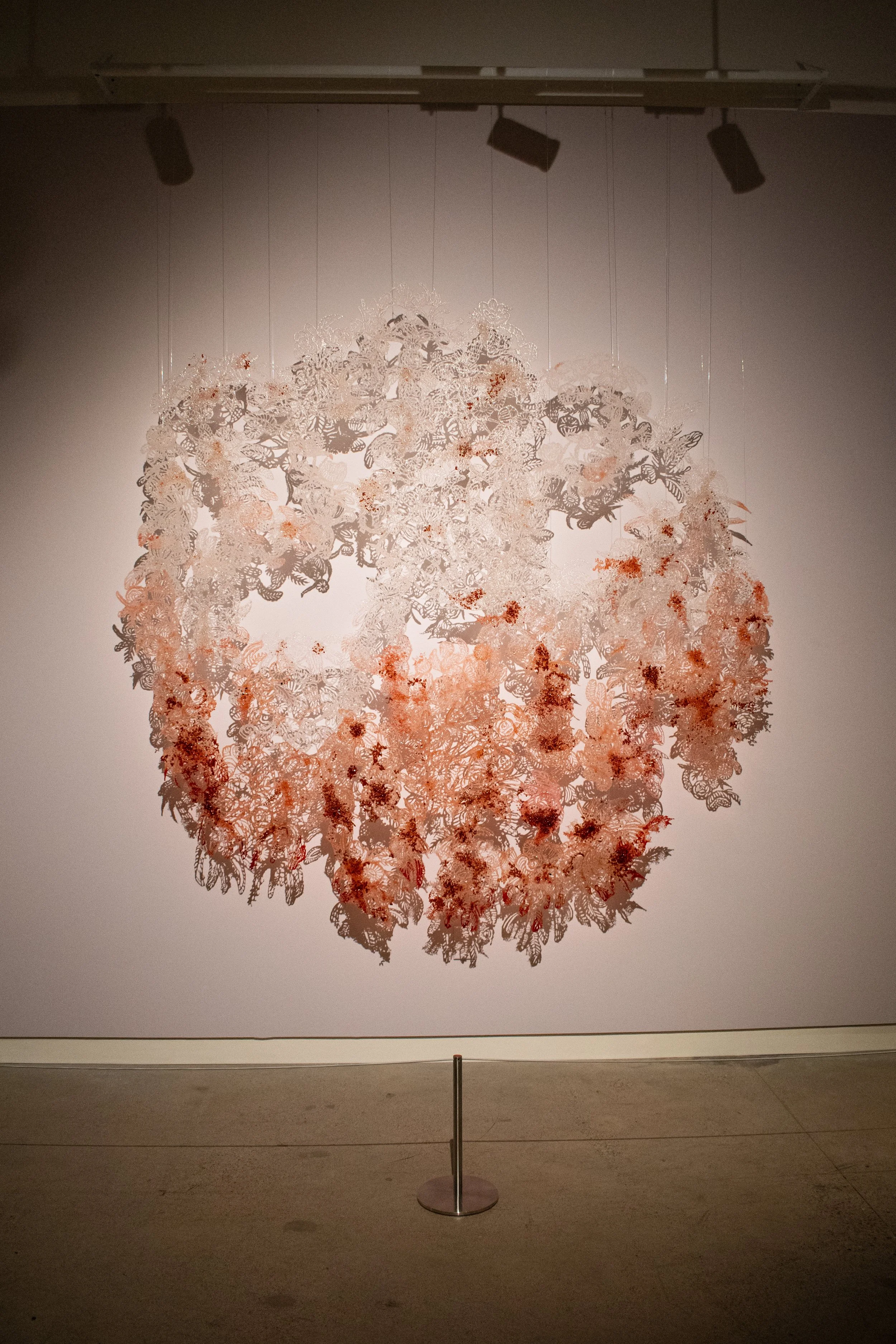
Photo: Lighting from one source.
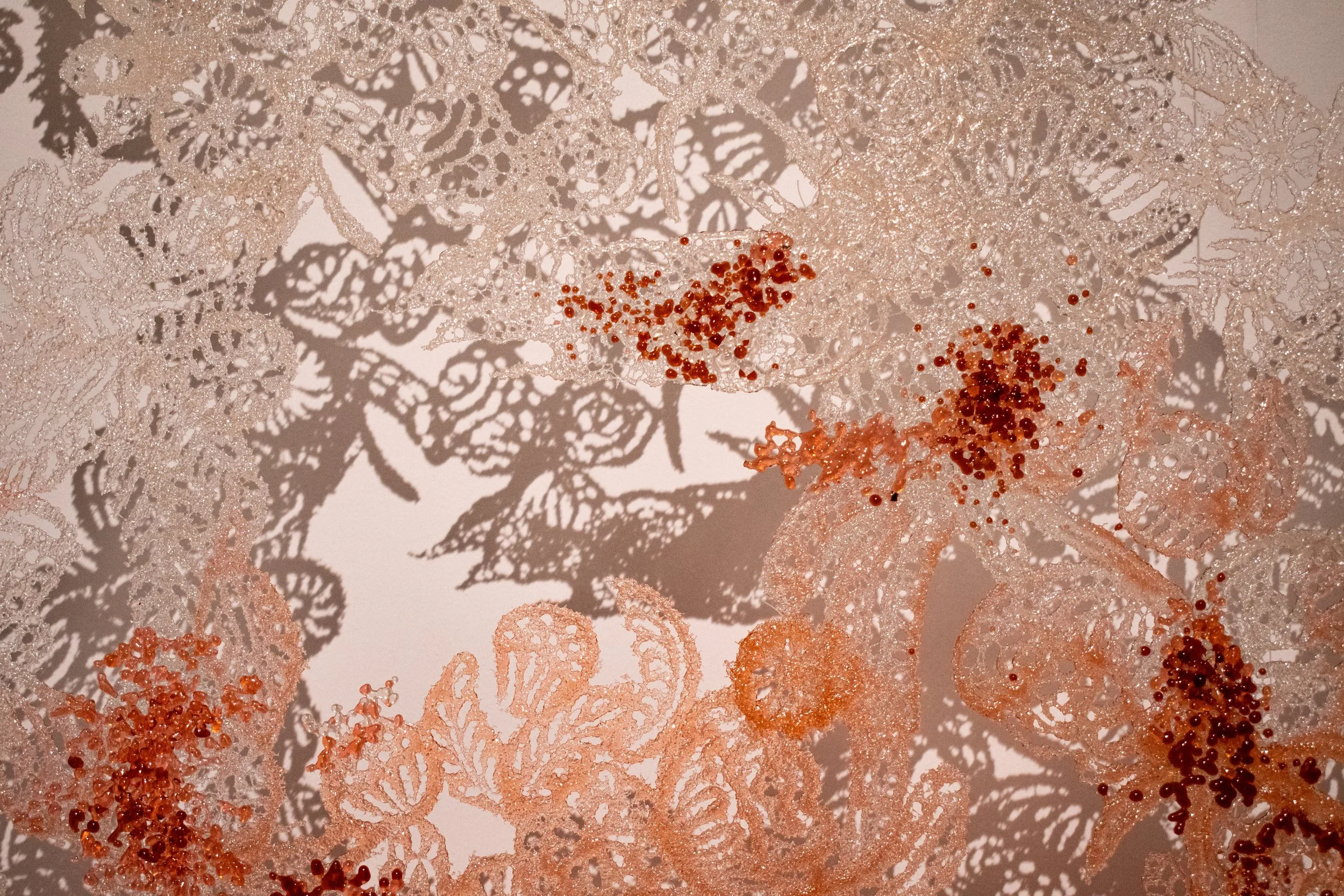
Photo: Sharp and detailed shadows.
Visitors are responding to Stain just as I had hoped: with wonder, disbelief, and admiration. I am excited to continue this discussion with Kate, in person, later this month. I will be in conversation with her, seated right in front of Stain, on November 14. We hope you will join us!
Artist Conversation: Kate Clements with Linnea Seidling
Saturday, November 14, 6:00pm–8:00pm
Tickets sliding scale: $10, $15, or $30