
A Walk in the Woods
I recently finished watching the epic saga Game of Thrones, loosely based on life in the Middle Ages in Europe. In the first scene of the series, a man comes upon a gruesome scene of a massacre in the wintery forest. Body parts of men and women form a circle, and a dead young girl, eyes wide open in terror, is pinned to a tree by an arrow. The man who witnessed the killings returns to his horse and tells others about the human carnage. They immediately determine the horror rests firmly in the hands of Wildlings, perceived as savage people who choose to live outside of civilization in the forest. Soon, the men are attacked, not by Wildlings but by supernatural beings, zombie-like creatures that roam the forests in search of human flesh.
Setting a gruesome scene within an otherwise quiet wintery forest is a clever shorthand for viewers growing up with Grimms fairytales or listening to scary ghost stories over a campfire in the woods. As humans, we often have complex and often ambiguous relationships with nature, largely guided by unexamined psychological and social perceptions of the very nature of nature itself. Nature can be seen as serene, calm, and full of wonder, yet also perceived as a place where danger, darkness, and the supernatural reside.
Believe it or not, the forests in Game of Thrones have a lot in common with our current exhibition Meet Me in the Forest. And as we enter the Halloween season, I wanted to share a few of our exhibition’s dark and haunting works of natural worlds. Like scenes you find in Game of Thrones, artists in the exhibition pair darkness with enchantment to heighten psychological affect. Take Inka Essenhigh’s painting Forest with Dappled Light, the first work of art you encounter when you enter the gallery space. Essenhigh renders a supernatural and mysterious forest of swaying trees and dancing branches. Soft rays of sunshine pour into the forest, while strange blue vines and liquid electric green moss cover the forest floor. The painting may stir your internal mind to say, something is happening here, yet you may not be able to say what the something really is.
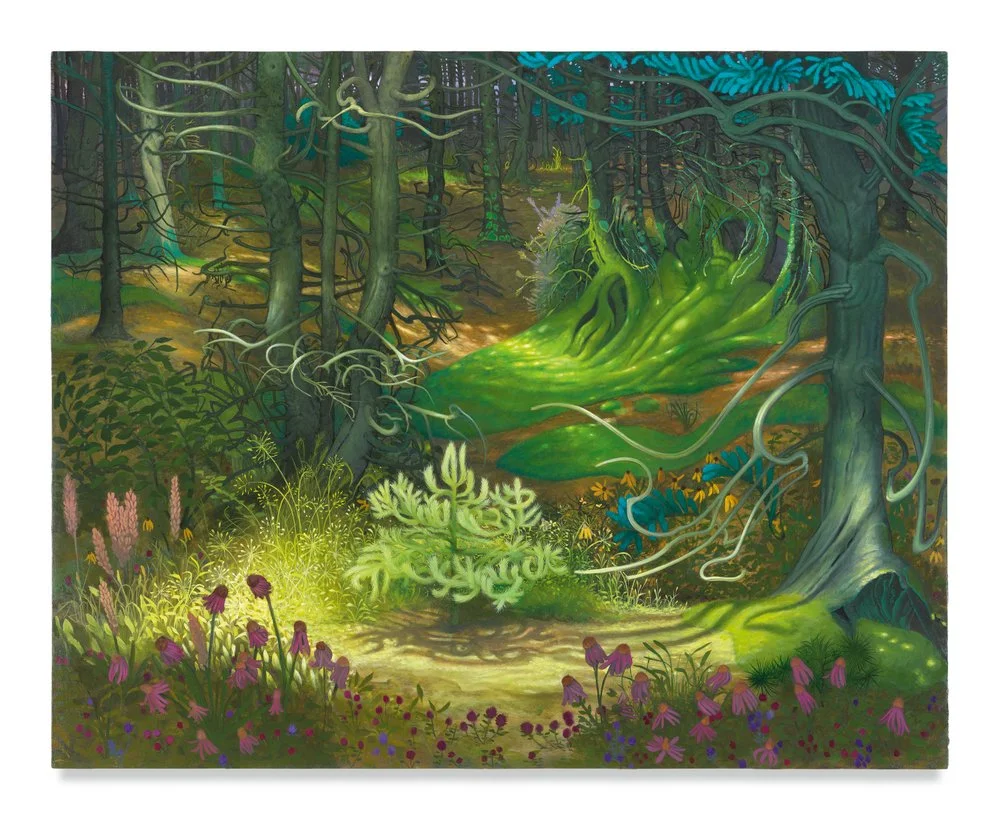
Inka Essenhigh (born 1969). Forest with Dappled Light, 2022. Enamel on canvas. 40 x 50 inches. Collection of the Farnsworth Art Museum, Rockland, Maine. Museum purchase, Lynne Drexler Acquisition Fund, 2022.30. © Inka Essenhigh / Image courtesy of the artist and Miles McEnery Gallery, New York, NY.
As you walk further into the gallery, you’ll come upon one of four Paul Stankard’s glass paperweights in the show. On the front of the paperweight, a blissful bouquet of small glass flowers appears within the core of the glass orb. It’s a lovely piece of art that might look beautiful on your desk at home. As you move to look at its other side, you notice a ghostly figure of a man’s face screaming in panicked horror. The once delicate paperweight becomes a haunting nightmare. Near Stankard’s work, a dark and eerie painting Underground appears. Moody and dark, you discover yourself encountering a rendering of a flowing green river in a deep underground cave. It is ominous and beautiful at the same time.
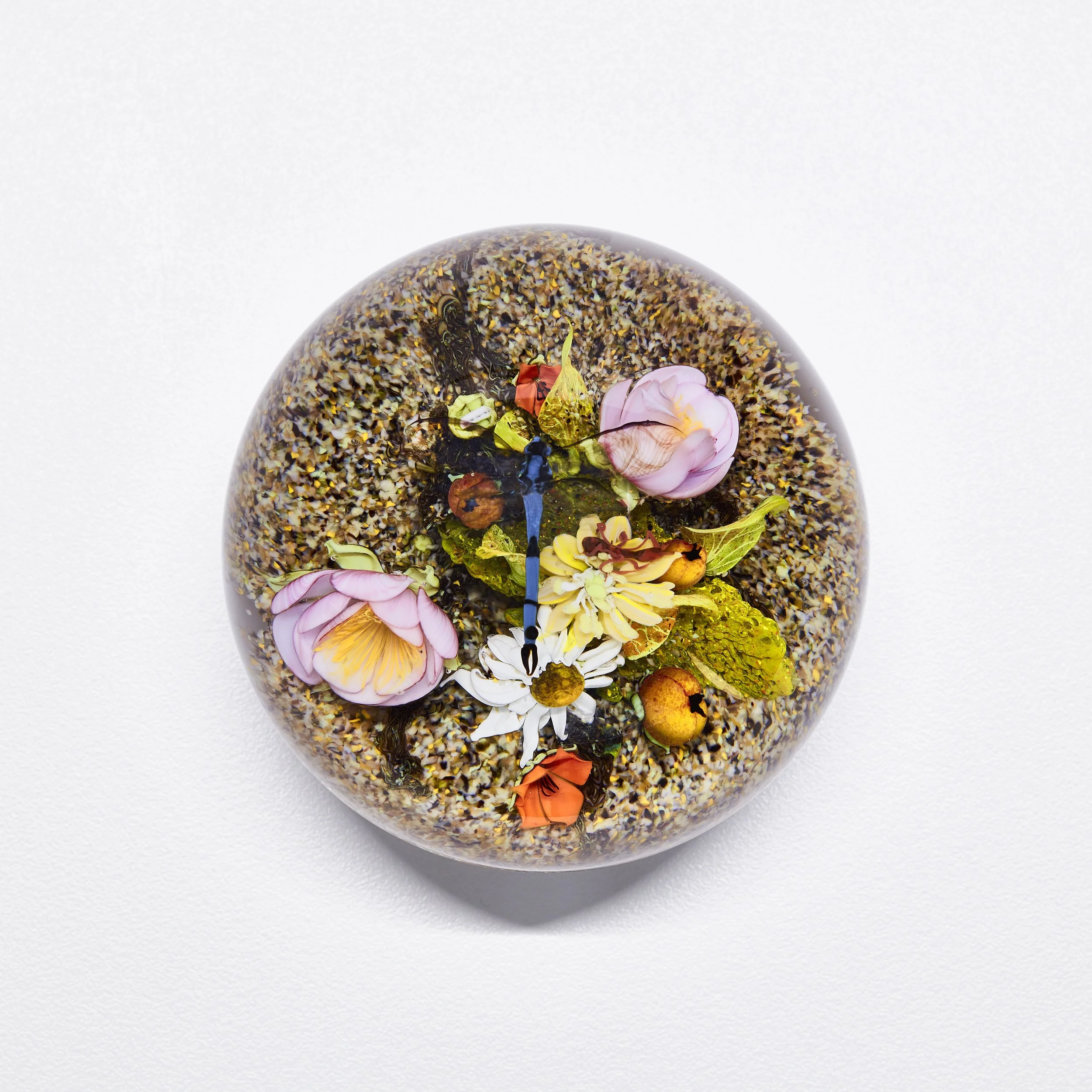
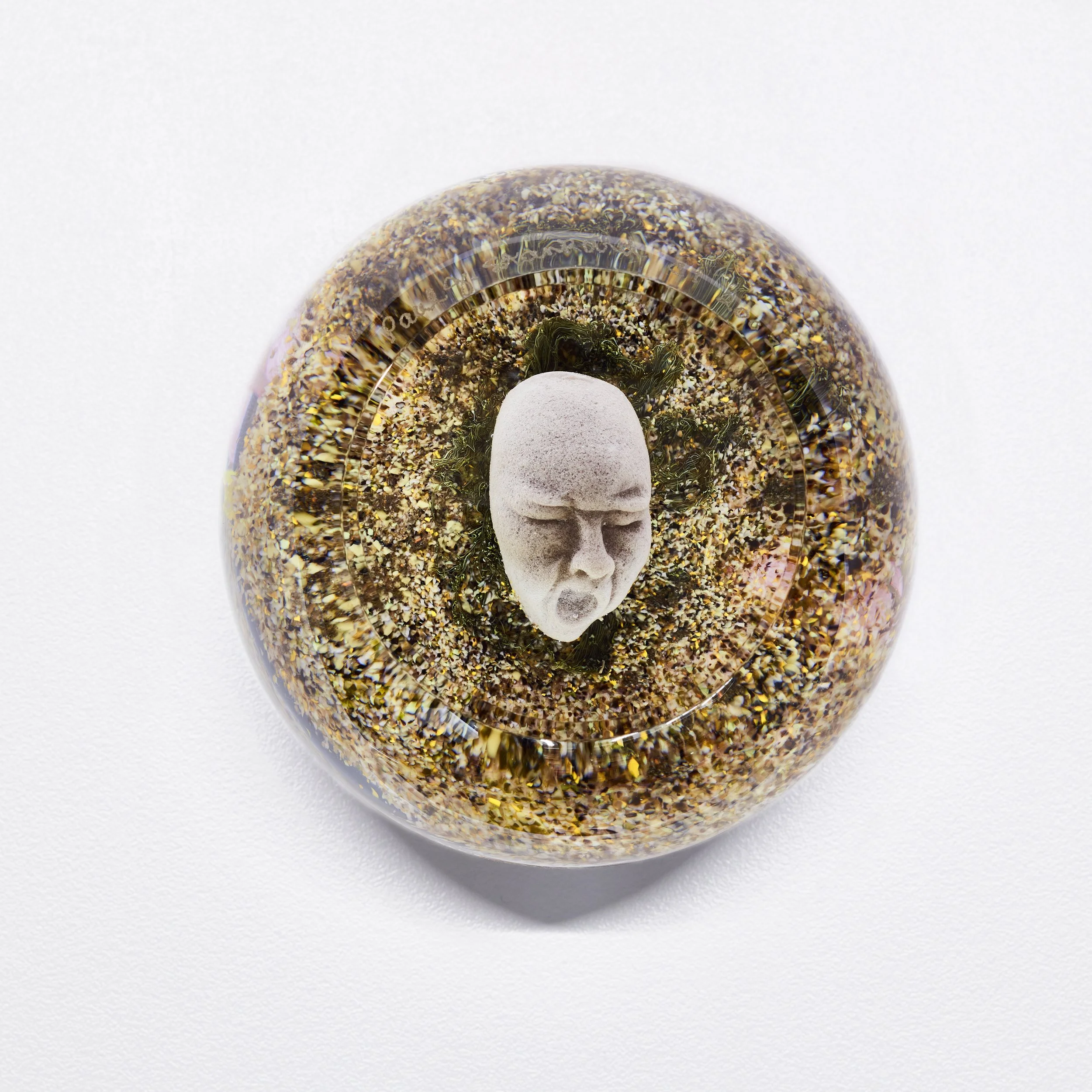
Paul Stankard (American, born 1943) Damselfly and Mask, 2002, Flameworked, encased, ground, polished, and laminated glass, 2 5/8 x 3 1/4 inches, Cafesjian Art Trust Museum, 2022.1654.1 © Paul Stankard
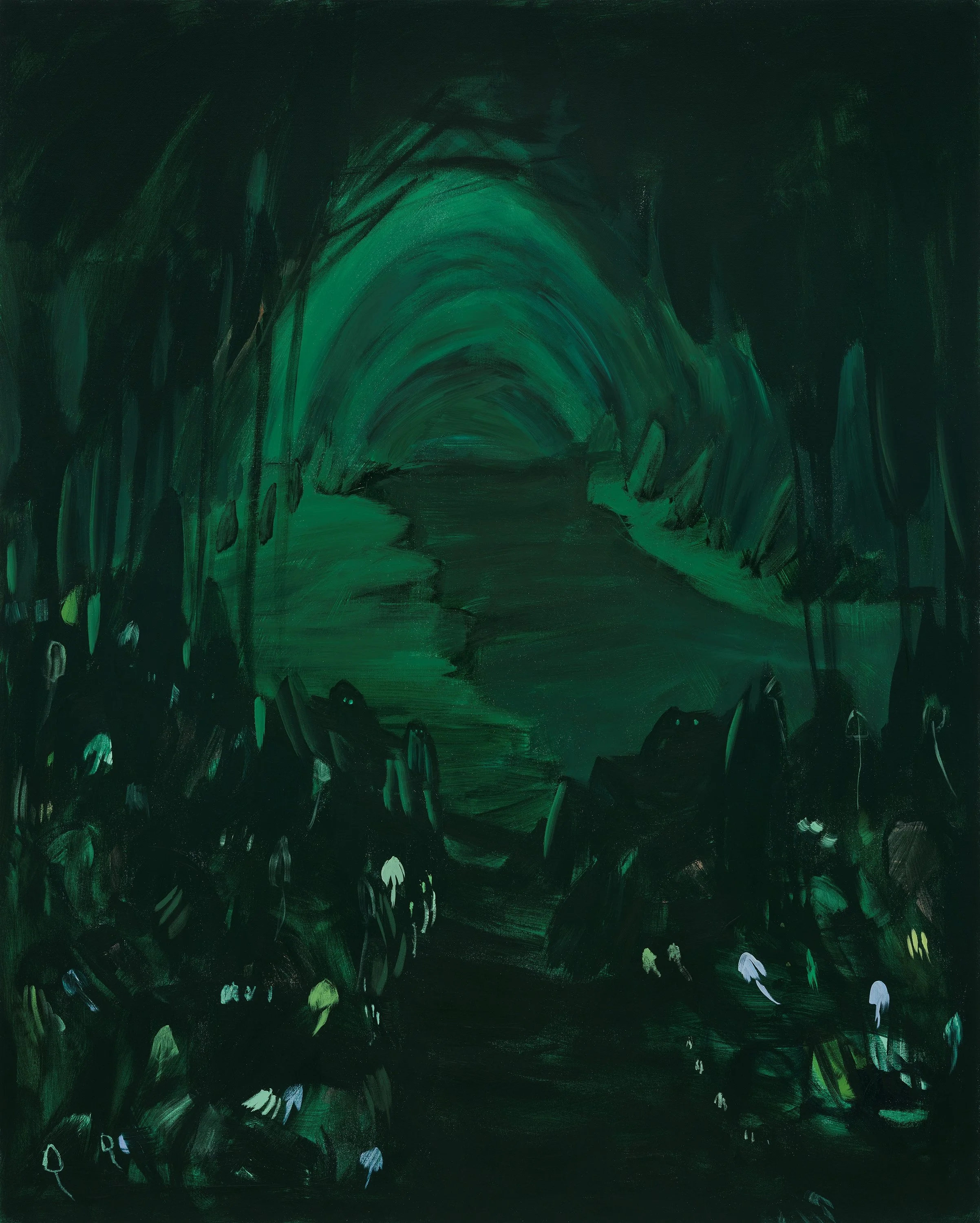
Hannah Secord Wade (American, born 1981), Underground, 2022, acrylic on linen, 60 x 48 inches. Collection of the Farnsworth Art Museum, Rockland, Maine. Museum purchase, Lynne Drexler Acquisition Fund, 2022.31. © Hannah Secord Wade / Photography by Anthony Campagnoli and Lane Gower
Writers, directors, and artists have long understood that our ideas of nature are often mirrors to ourselves, reflecting a society’s morals, values, and beliefs. Our perceptions of what nature is and is not reveal much more about humankind than anything, and nature becomes a stage where cautionary tales of human darkness and destruction take place. Amanda Michelle Smith creates work revealing the darkness of humanity in painted ceramic tile forests. When Trauma Comes to Town presents innocence lost within a forest of bubbly flowers in a blackened sky. Smith’s protagonist in the story—a young girl in a dress—finds herself in the grips of a red-clawed creature. The claw is trauma, and the young girl internalizes its massive weight, falling victim to human darkness within a magical natural realm. Lori Nix draws upon the psychologies of humankind as well, in the photographic work entitled Floater. The photographic scene, carefully choreographed and artificially made, reveals a dead body floating face down in otherwise quiet and serene marshlands. The artist’s desire—constructing a dark fiction that tricks the eye—relies on the viewer’s voyeuristic impulses. We want to gaze at an image of a death, moving towards (rather than away from) our best moral judgement. Meanwhile, the marshlands remain unbothered and calm.

Amanda Michelle Smith (American) When Trauma Comes to Town, 2025, Glazed ceramic, oil paint, 16 × 21 1/16 × 1 1/4 inches, Cafesjian Art Trust Museum, 2025.044.1 © Amanda Michelle Smith
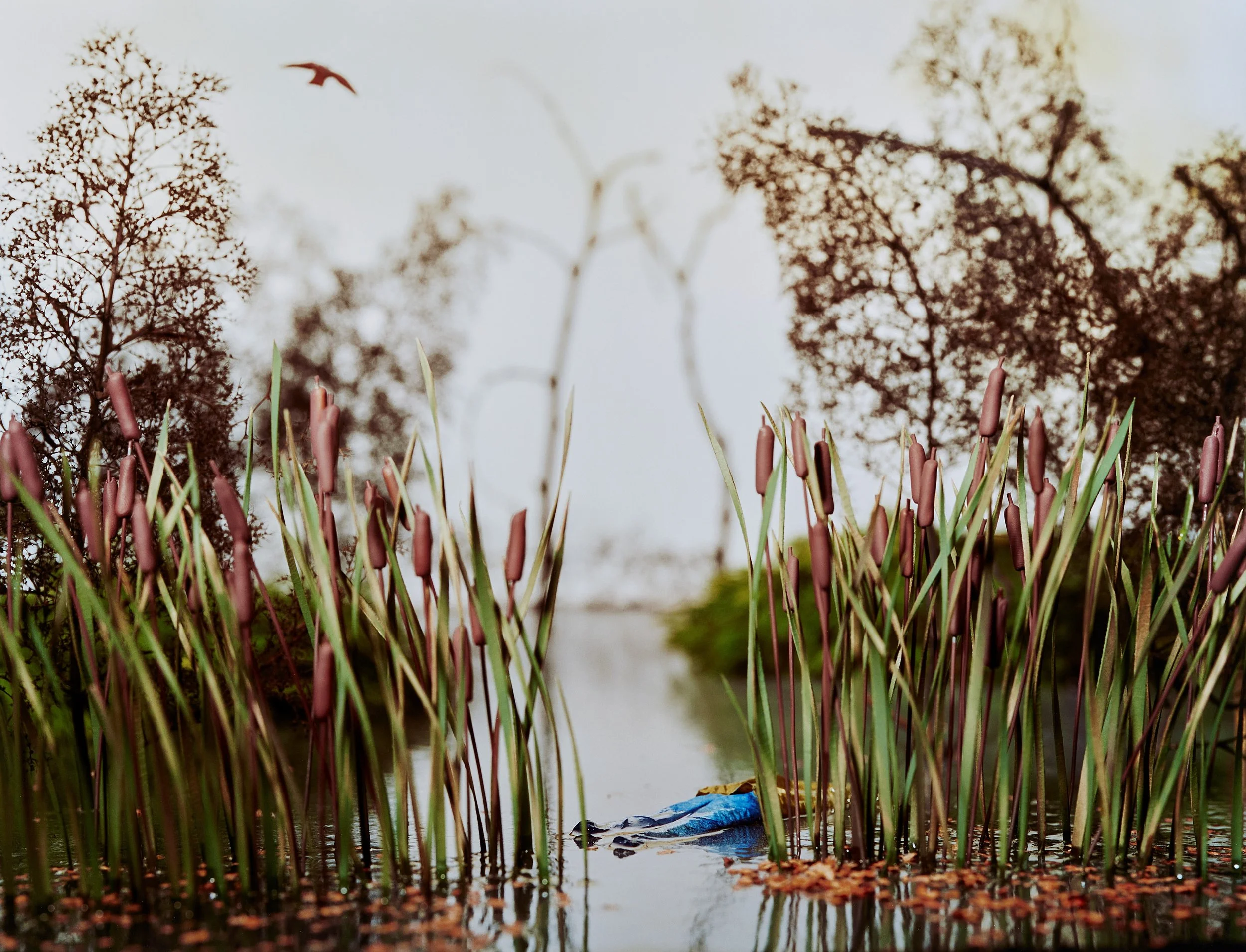
Lori Nix (American, born 1969) and Kathleen Gerber (American, born 1967) Floater, 2001, Archival pigment print, 40 x 53 inches, Cafesjian Art Trust Museum, 2025.048.1 © Lori Nix and Kathleen Gerber
I hope that you enjoy this season, where haunted forests and supernatural beings come alive. See all of the works of art mentioned above in Meet Me in the Forest and more, and take your own epic journey into the dark and magical woods.