
Meet Me in the Forest: What Will You Meet Within?
This Thursday evening, the Cafesjian Art Trust Museum will open its most ambitious exhibition to date. Meet Me in the Forest features 21 artworks that explore the complex relationship between the natural world and humankind. This immersive exhibition will highlight contemporary artworks across a range of media rarely seen together—a concept important to the CAT’s curatorial team. Paintings, textiles, mixed-media, glass, ceramics, photography, and large-scale installation come together to create unexpected connections. Below are just four of the myriad narrative threads that weave these artworks together.
Imagined Nature
Many of the artworks featured in Meet Me in the Forest depict nature subjectively, with added expression, symbolism, and imagination. One such artist is Paul Stankard, famed for his incredible skill in recreating plant life in flameworked glass. Four paperweights by Stankard are placed around the exhibition, each coming from a different moment in his more than 60-year career. We hope visitors take the time to revel in these miniature worlds.

Paul Stankard (American, 1943—2026) Strawberry Blossom, 1979, Flameworked, encased, ground, polished, and laminated glass, 2 1/4 × 2 3/4 inches, Cafesjian Art Trust Museum, 2022.1662.1 © Paul Stankard
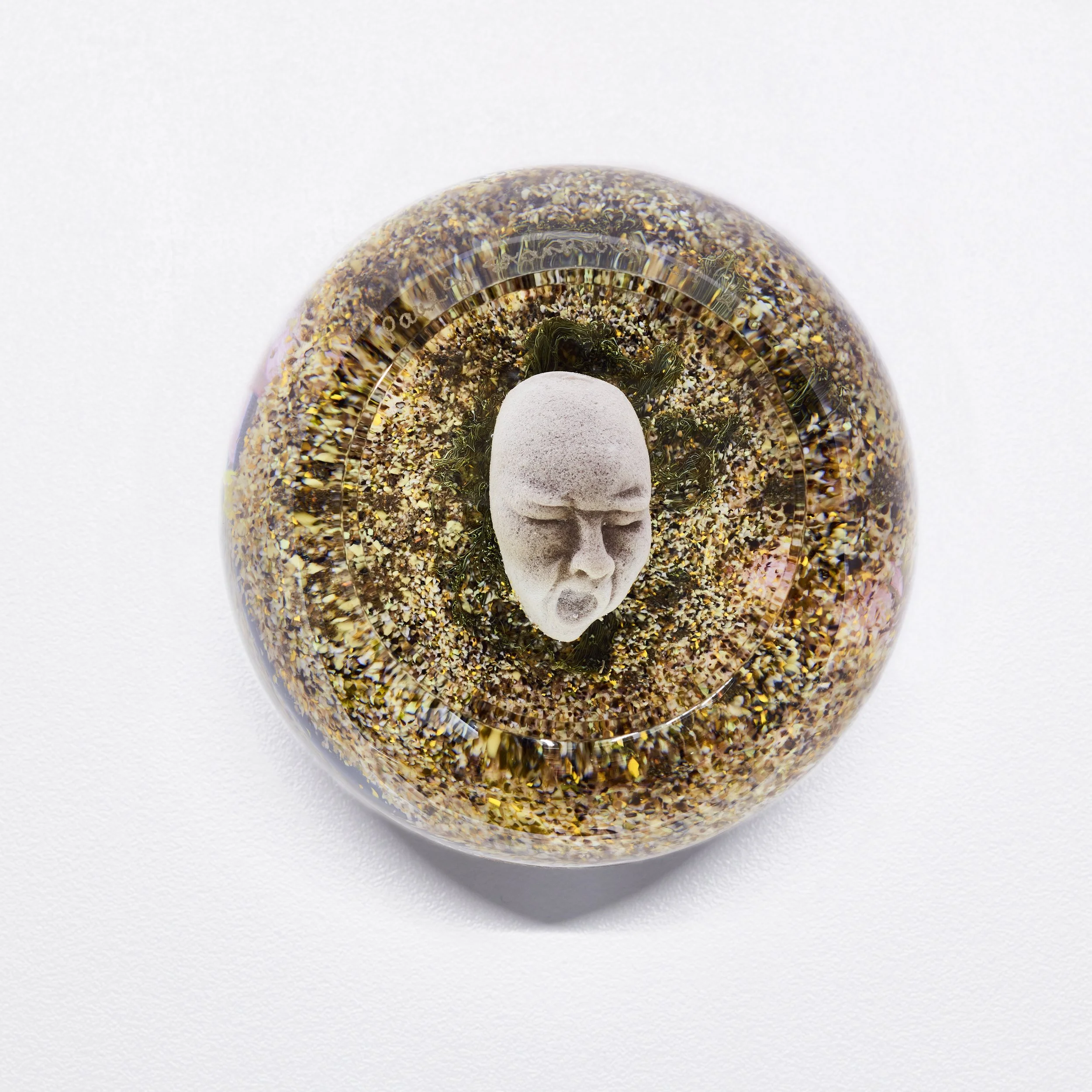
Stankard is part of a lineage of glass flower makers, building on a foundation set by Leopold (1822–1895) and Rudolf Blaschka (1857–1939), famed Czech glass artists who made scientific models of flowers and plants in the late 1800s and early 1900s. Stankard’s Strawberry Blossom (1979) is representative of his earlier work, capturing the plant with Blaschka-like naturalism. Over time, however, Stankard began to explore and celebration the magic inherent both in flowers and in the process he uses to replicate them in glass, a technique known as flameworking. Creating clusters of blossoms with glass rods at a focused flame felt magical to Stankard—that he could create something out of practically nothing. He thus began incorporating magical beings in his sculptures. Small human figures appear among tangled roots in Botanical Earth Spirits, and a screaming face is hidden beneath the ground’s surface in Damselfly and Mask. Stankard turned to surreal human bodies to represent the life force in the plants he depicts.
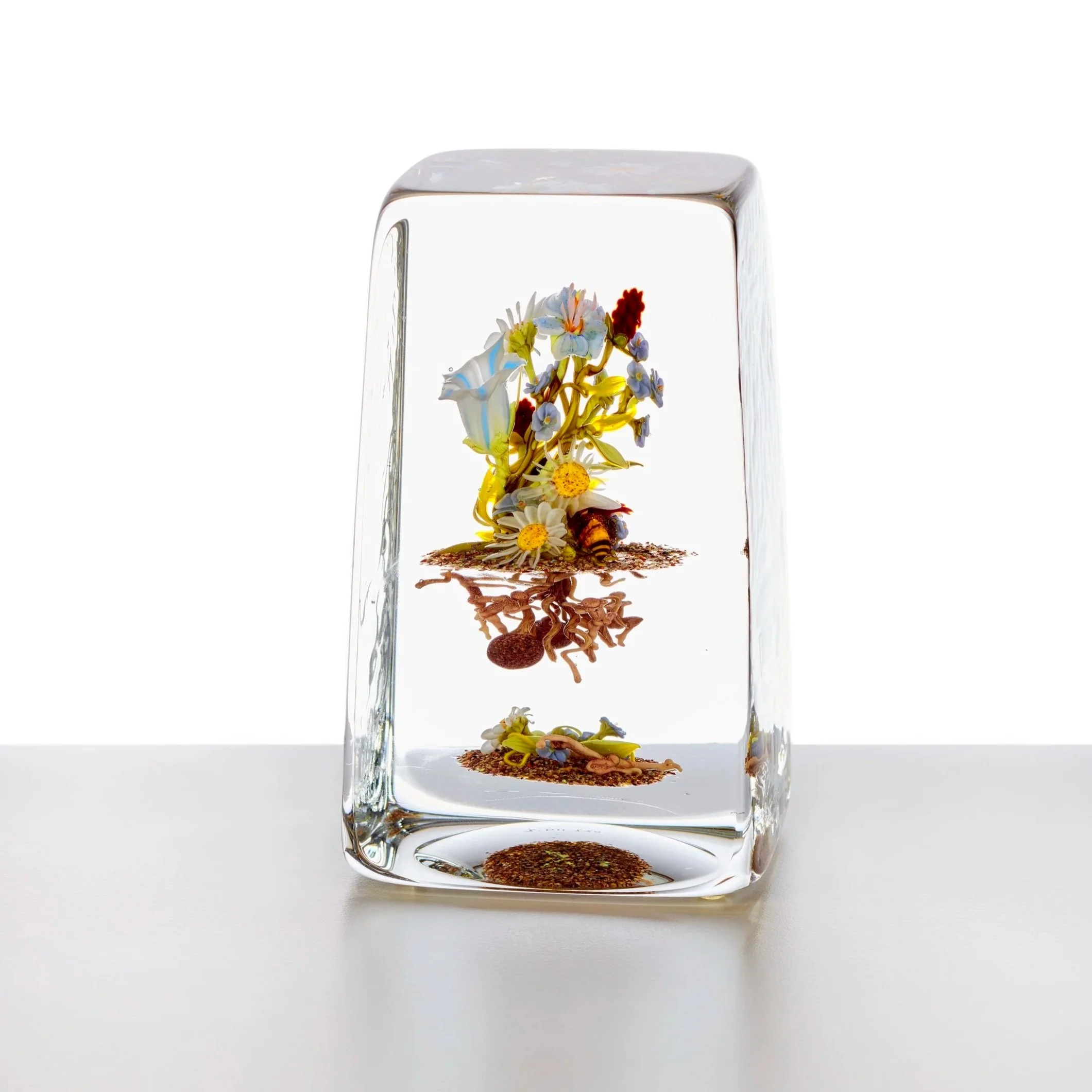
Paul Stankard (American, 1943—2026) Botanical and Earth Spirits, undated. Flameworked, encased, ground, polished, and laminated glass. 5 x 3 x 2 ¾ inches. Cafesjian Art Trust Museum, 2022.1648.1. © Paul Stankard
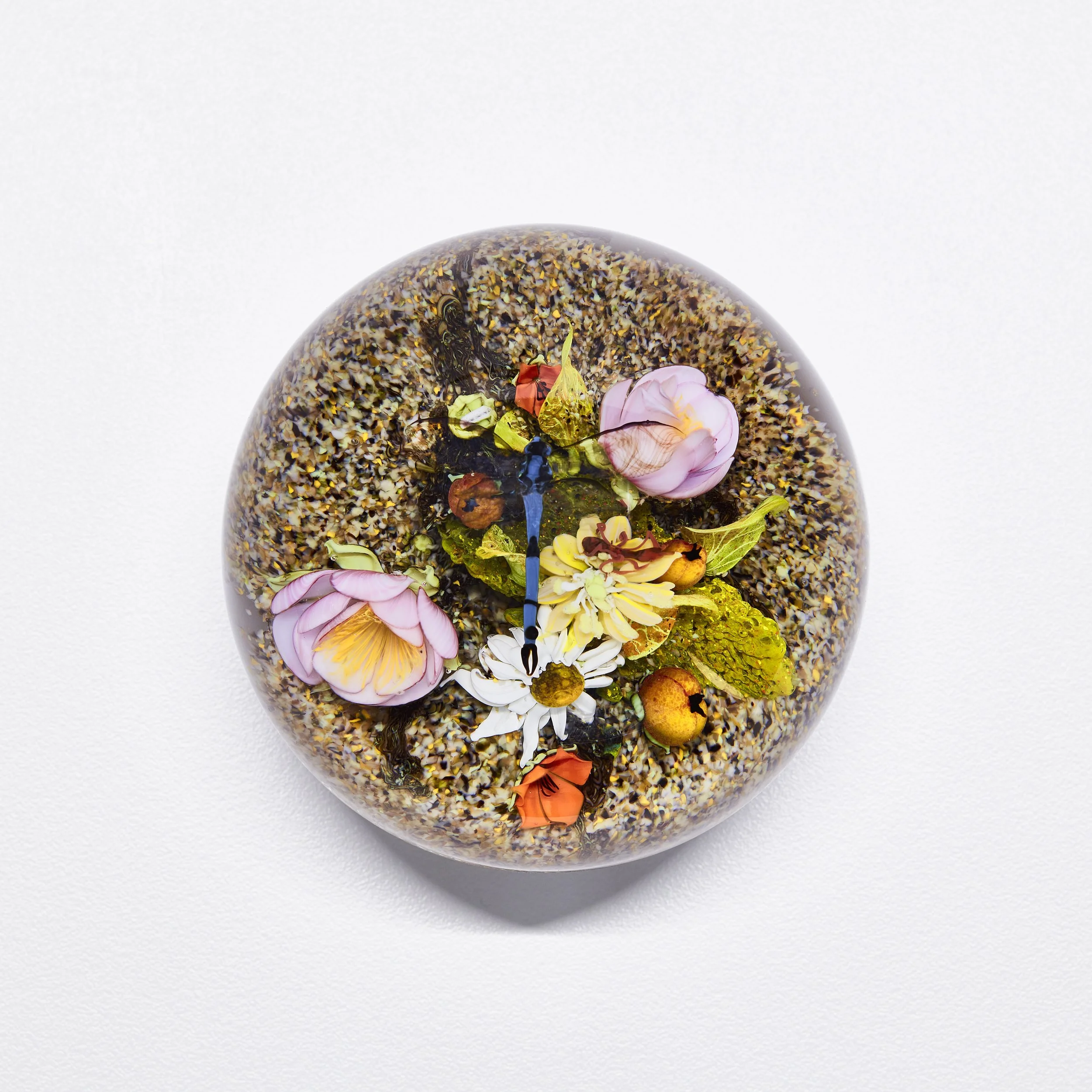
Recto: Paul Stankard (American, 1943—2026) Damselfly and Mask, 2002, Flameworked, encased, ground, polished, and laminated glass, 2 5/8 x 3 1/4 inches, Cafesjian Art Trust Museum, 2022.1654.1 © Paul Stankard
Verso: Paul Stankard (American, 1943—2026) Damselfly and Mask, 2002, Flameworked, encased, ground, polished, and laminated glass, 2 5/8 x 3 1/4 inches, Cafesjian Art Trust Museum, 2022.1654.1 © Paul Stankard
Artist Hannah Wade similarly departs from the realities of nature in favor of an imagined dreamscape. Underground depicts a subterranean river, passing through a lightly glowing cave. Wade took inspiration from adventure computer games of the 1990s made by the company LucasArts. These virtual worlds from her childhood were a safe space. Here, she has left the landscape absent of people or animals who might create a narrative, leaving the story and tone of the painting up to the viewer. Will they see a scene of tranquility, safety, adventure, or foreboding?
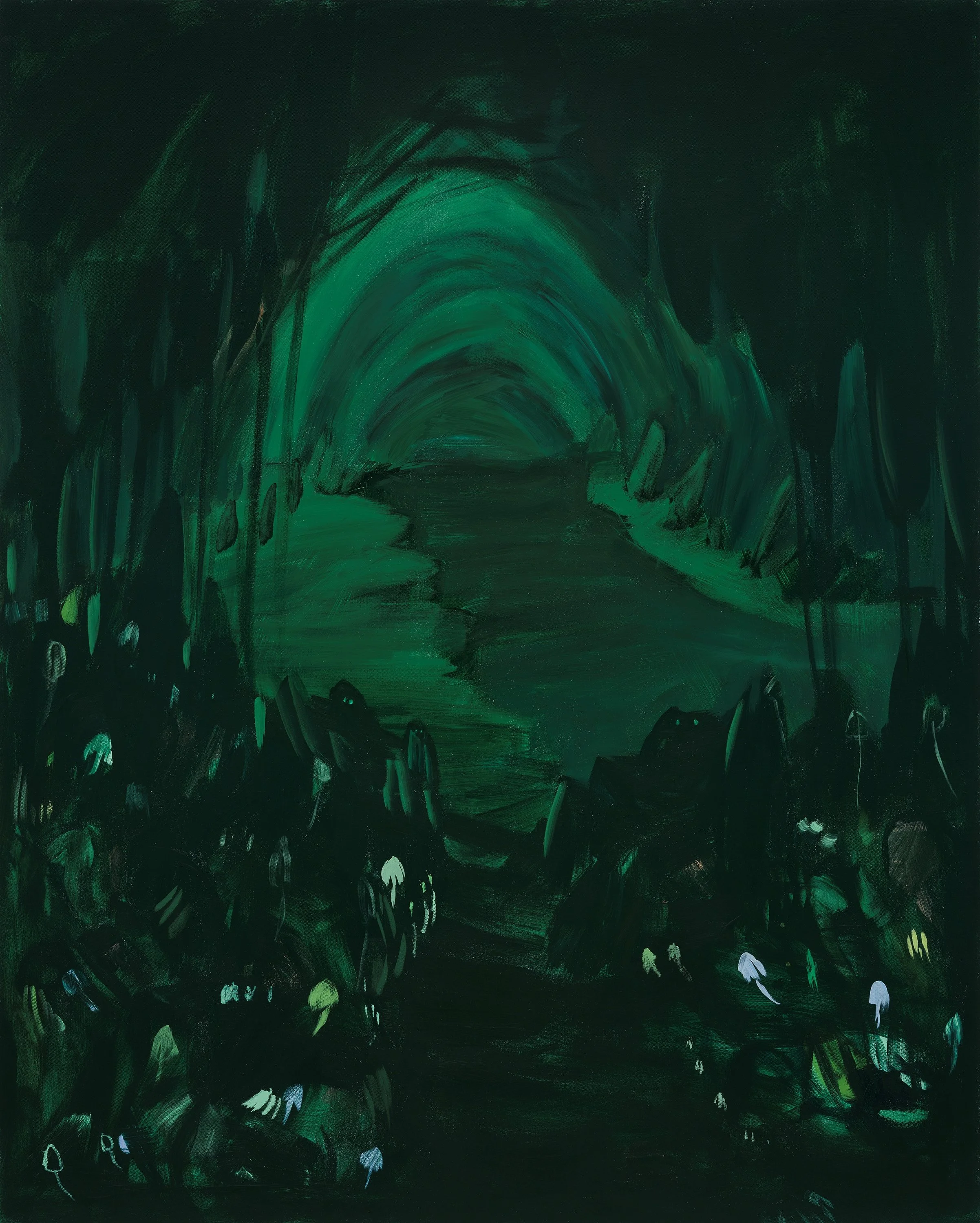
Hannah Secord Wade (American, born 1981) Underground, 2022, acrylic on linen, 60 x 48 inches. Collection of the Farnsworth Art Museum, Rockland, Maine. Museum purchase, Lynne Drexler Acquisition Fund, 2022.31. © Hannah Secord Wade / Photography by Anthony Campagnoli and Lane Gower
Nature and the Body
Meet Me in the Forest features many artworks that explore the intersection of nature and the body. One such work is Atabey by Ana Mendieta, generously on loan from the Walker Art Center in Minneapolis. This large photograph depicts a figure that the artist carved onto the wall of a cave in Jaruco National Park in Cuba. She created this artwork during her first visit back to Cuba after more than 20 years living in the United States. She immigrated to the United States at age 12 as a part of Operation Pedro Pan, a government initiative to help children escape Cuba’s communist regime. Mendieta and her sister were placed in Iowa, where they grew up in group homes, boarding schools, and foster care. Mendieta described creating the series of photographs, of which Atabey is a part, as “an intimate act of communion with the earth, a loving return to the maternal breasts.” The artist named the figure Atabey, a zemi (ancestral spirit) in the tradition of the Taíno, an Indigenous group native to the Greater Antilles. Atabey is the consciousness of Mother Earth and takes the form of a woman. In this photograph, Mendieta fuses her own form with that of Atabey, connecting her to the land and repairing bonds broken during her childhood.
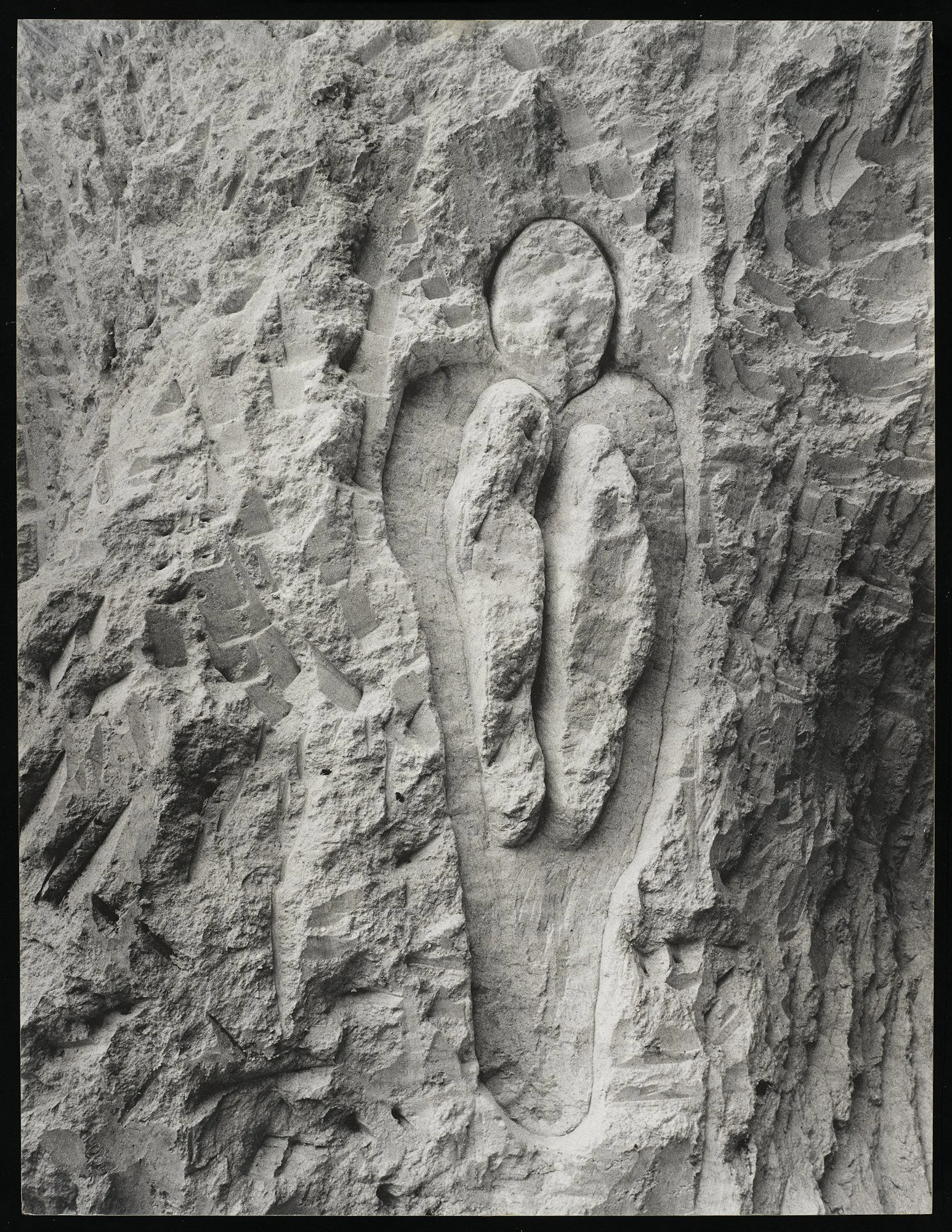
Ana Mendieta (Cuban-American, 1948-1985) Atabey, 1981, Gelatin silver print, 53-1/4 x 40-1/4”, Collection Walker Art Center, Minneapolis, Gift of Mary and John Pappajohn, 2015. © 2026 The Estate of Ana Mendieta Collection, LLC / Licensed by Artists Rights Society (ARS), New York
Another fusion of the body and nature occurs in Kate Clement’s glass sculpture Stain, in which the artist explores the qualities shared by glass and the human body. Clements uses the classic beauty of flowers and the irresistible sparkle of glass to entice viewers. Composed of 43 separate elements made of fused glass frit (crushed glass), Stain is a floating cloud of delicate flowers that is colorless at the top and gradually turns pink, and then red, towards the bottom. The viewing experience of this sculpture comes in waves: wonder and awe are quickly replaced with curiosity, anxiety, and disgust. The logistics of the sculpture are nerve-wracking. How are these wafer-thin pieces of glass hanging in the air? Will they fall? The beautiful pink glass transitions into not just red, but blood droplets and dark scabs. Like glass, the body has resilience and strength, but it can also be destroyed with a single violent act.
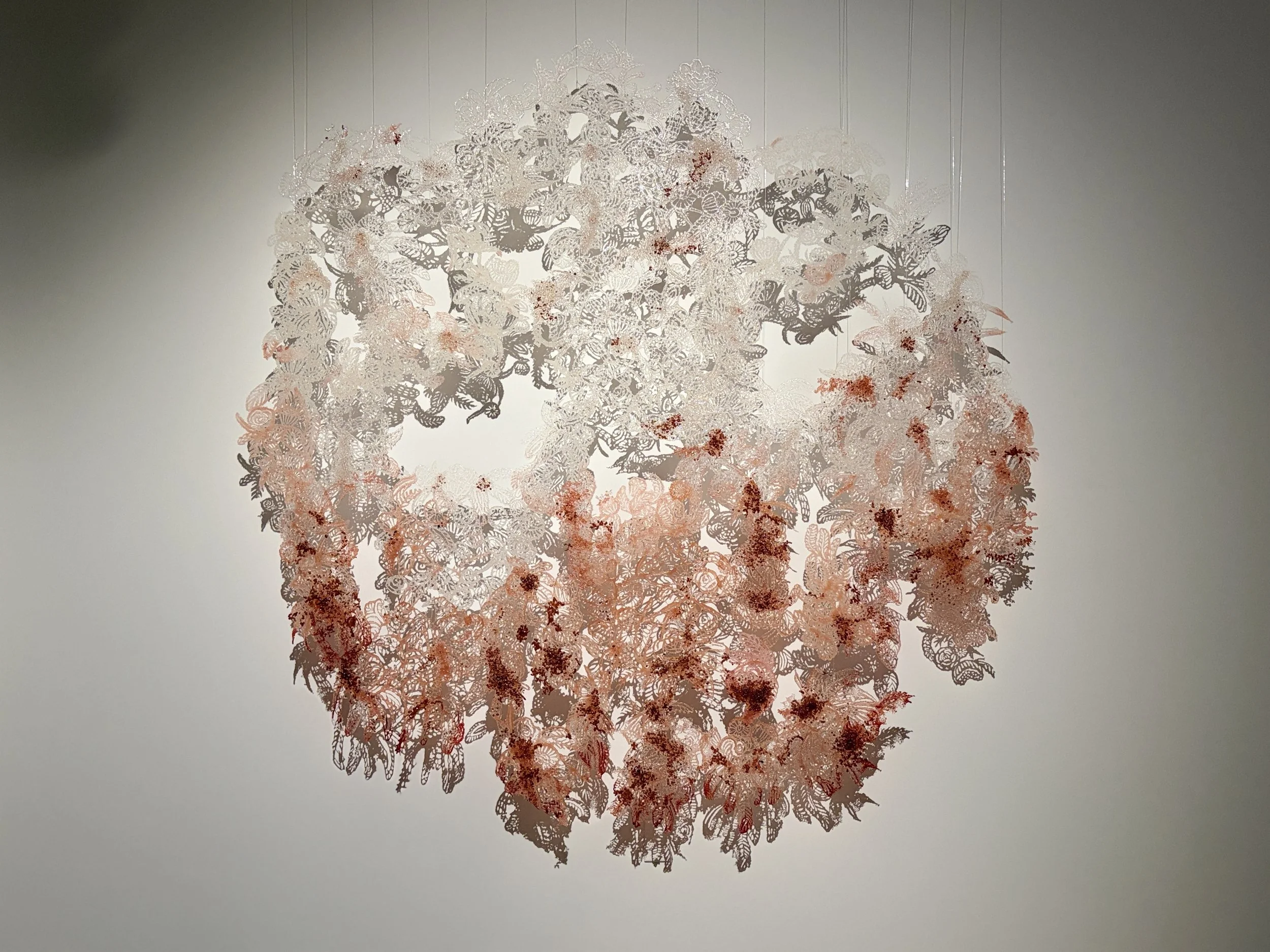
Kate Clements (American, born 1989) Stain, 2016, Kiln fired glass and monofilament, 90 x 96 x 1/4 inches, Cafesjian Art Trust Museum, 2025.049.1 © Kate Clements
Storied Nature
Artists Pao Houa Her and Carrie Mae Weems both use photography to capture history and stories held in forests. In an untitled photograph from her series Pictures of Paradise, Her depicts a lush forest in Thailand, where she and her family fled in 1983, when she was a small child. They left their homeland of Laos due to the violence in the aftermath of the Laotian Civil War (also called the Secret War). Her family ultimately settled in Minnesota, which hosts the largest Hmong community in the United States. The photograph of the poppies that Her has superimposed on top of the forest was taken in her mother’s garden in Minnesota. Her captures the complexities of this tropical forest, simultaneously a “paradise” and a witness to great suffering.
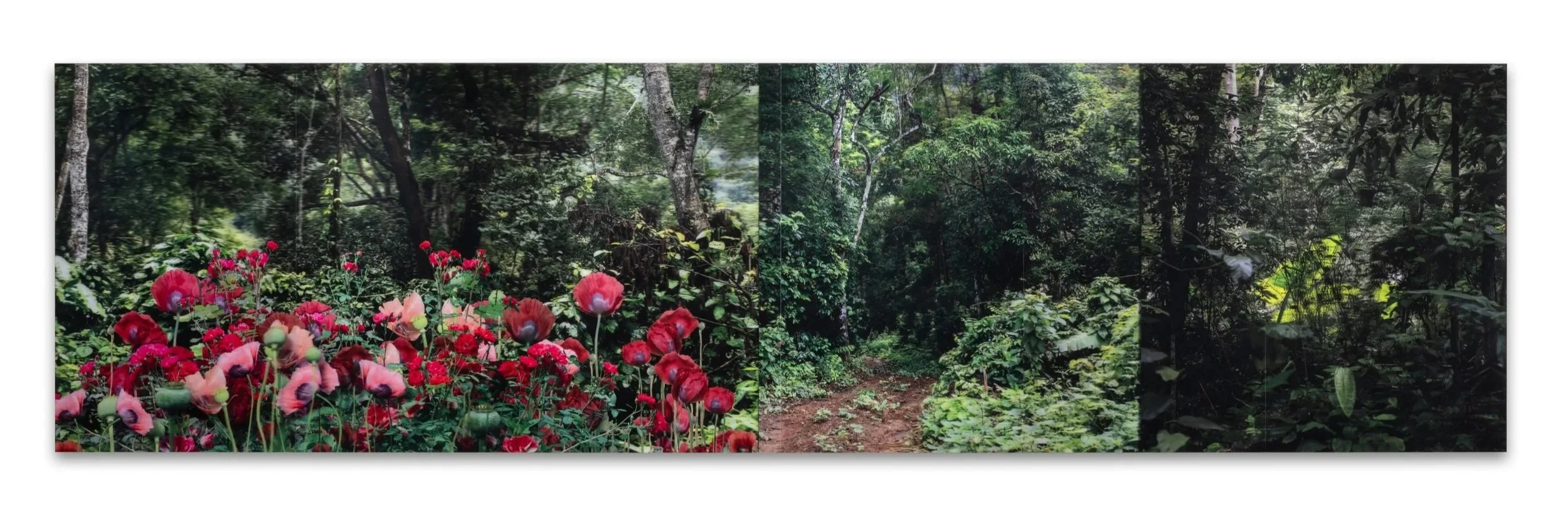
Pao Houa Her (Hmong American, born 1982) Untitled from the series Pictures of Paradise, 2022-2024, 3D lenticular prints mounted on panel, 70 x 264 inches. Courtesy the artist and Bockley Gallery. © Pao Houa Her
The CAT is honored to welcome on loan the photograph Untitled (Box Spring in Tree) by Carrie Mae Weems. The artist took this photo on the Sea Islands of South Carolina and Georgia in 1992. When she was young, her father told her stories about the Gullah Geechee people who lived on these islands, descendants of enslaved people from Africa. Weems traveled to these islands in the early 1990s as a pilgrimage, to experience and document Gullah Geechee culture and history. Many photographs in the Sea Island Series depict the Gullah Geechee’s relationship with the land, like Untitled (Box Spring in Tree). A wedged box spring was placed between trees for spiritual protection; the metal springs repelling bad spirits. This human intervention in the forest leaves viewers wondering about the past and future of this object: was it placed recently or decades ago? Who put it there, and what spirits or people did they fear? Will it remain in these woods and give protection into the future?
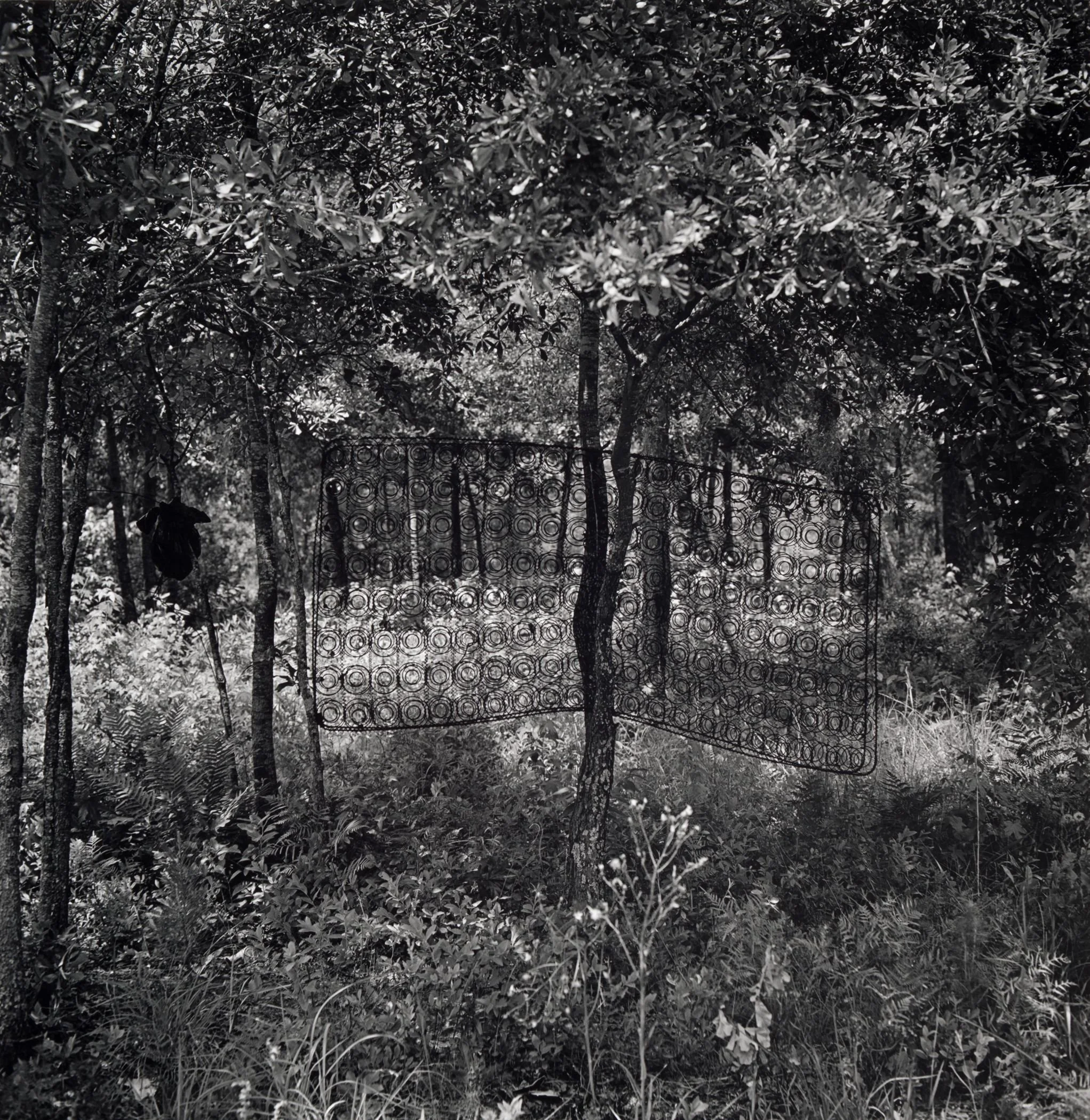
Carrie Mae Weems, Untitled (Box Spring in Tree), 1992, Gelatin silver print, Edition 7 of 10 + 2 APs, 20 3/4 x 20 3/4 x 11/2 inches, Courtesy the artist and Gladstone Gallery © Carrie Mae Weems
The Social Life of the Forest
The title of this exhibition, Meet Me in the Forest, evokes a mysterious conversation between people. Who are they? Why do they need to meet in the forest? Forests, swamps, and gardens are the settings for all kinds of human interactions, whether healing, violent, or romantic. Two artworks in this exhibition exemplify the social interactions that occur in these spaces. Lori Nix and Kathleen Gerber’s Floater is a reminder that nature is at times a place for human brutality. Nix cites photojournalism, action and science fiction movies, cartoons, and natural disasters as major influences. The scene depicted in Floater is at first glance idyllic, but with further inspection, a dead body emerges floating among the cattails. Nix invites viewers to guess what happened here. Was it a tragic accident or a conflict that ended in a murder? Nix depicts nature as an ambivalent host to the misfortune that befell the form floating in the water.
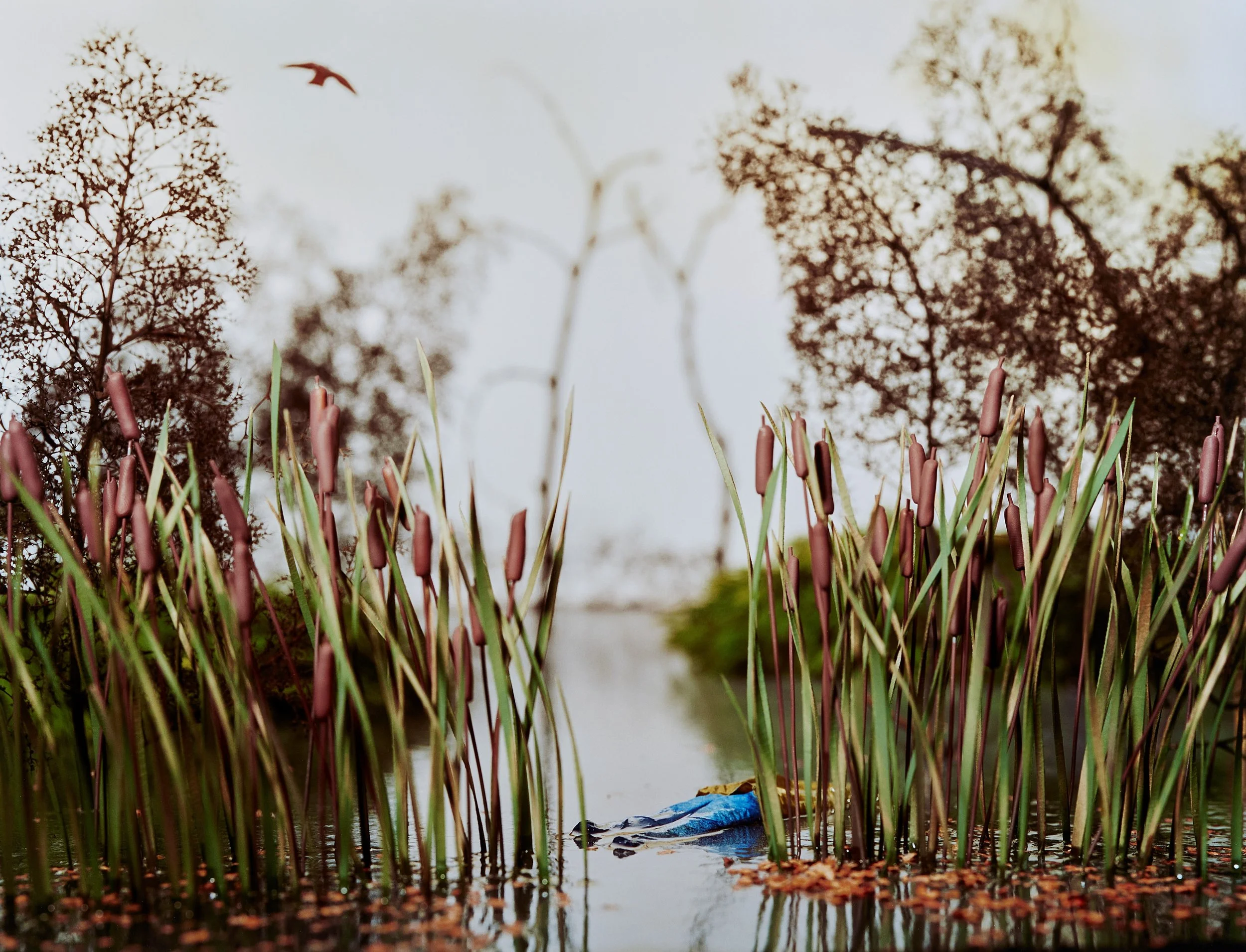
Lori Nix (American, born 1969) and Kathleen Gerber (American, born 1967) Floater, 2001, Archival pigment print, 40 x 53 inches, Cafesjian Art Trust Museum, 2025.048.1 © Lori Nix and Kathleen Gerber
The painting She taught me to listen to the wind, by Guadeloupean artist Kelly Sinnapah Mary, is on view for the first time at the CAT in Meet Me in the Forest. A recent addition to the museum’s permanent collection, the painting depicts a romantic rendezvous among cacao trees. Two women, one with darker skin and the other lighter, are entwined on top of a white animal pelt. The pair seem to be humans, with their recognizable feet, hands, and obscured faces, but the impossible tangle of their limbs and green tattoos of leaves, animals, and insects makes them appear as if from a magical realm. The menacing clawed hand of a creature, whose fur matches the pelt, reaches from the trees into the clearing. Sinnapah Mary’s supernatural scenes are inspired by Indo-Caribbean history and mythology, as well as her grandmother’s imparted knowledge. Under the cover of trees and plants, the natural world serves as a locale for clandestine romance in many cultures throughout time and geography.

Kelly Sinnapah Mary (Guadeloupean, born 1981) She taught me to listen to the wind, 2023, arcylic on canvas, 47 x 47 inches, Cafesjian Art Trust Museum, 2025.041.1 © Kelly Sinnapah Mary
Meet Me in the Forest is an invitation to us all, issued collectively by the artists (painters, glass artists, photographers, ceramists, and mixed-media artists; fine artists and craftspeople alike) in this exhibition. Meet them here and discover what they have uncovered, discovered, and created within these gardens, forests, swamps, and marshes.
Meet Me in the Forest is open at the CAT the evening of September 3, 2026 through February 27, 2027.
Meet Me in the Forest is organized by the Cafesjian Art Trust Museum’s Jill Ahlberg Yohe, Curator of Modern and Contemporary Art, and Linnea Seidling, Assistant Curator of Glass. The CAT expresses gratitude to the Des Moines Art Center, Farnsworth Art Museum, Walker Art Center, Bockley Gallery, and Gladstone Gallery for generously lending works of art to the exhibition.